
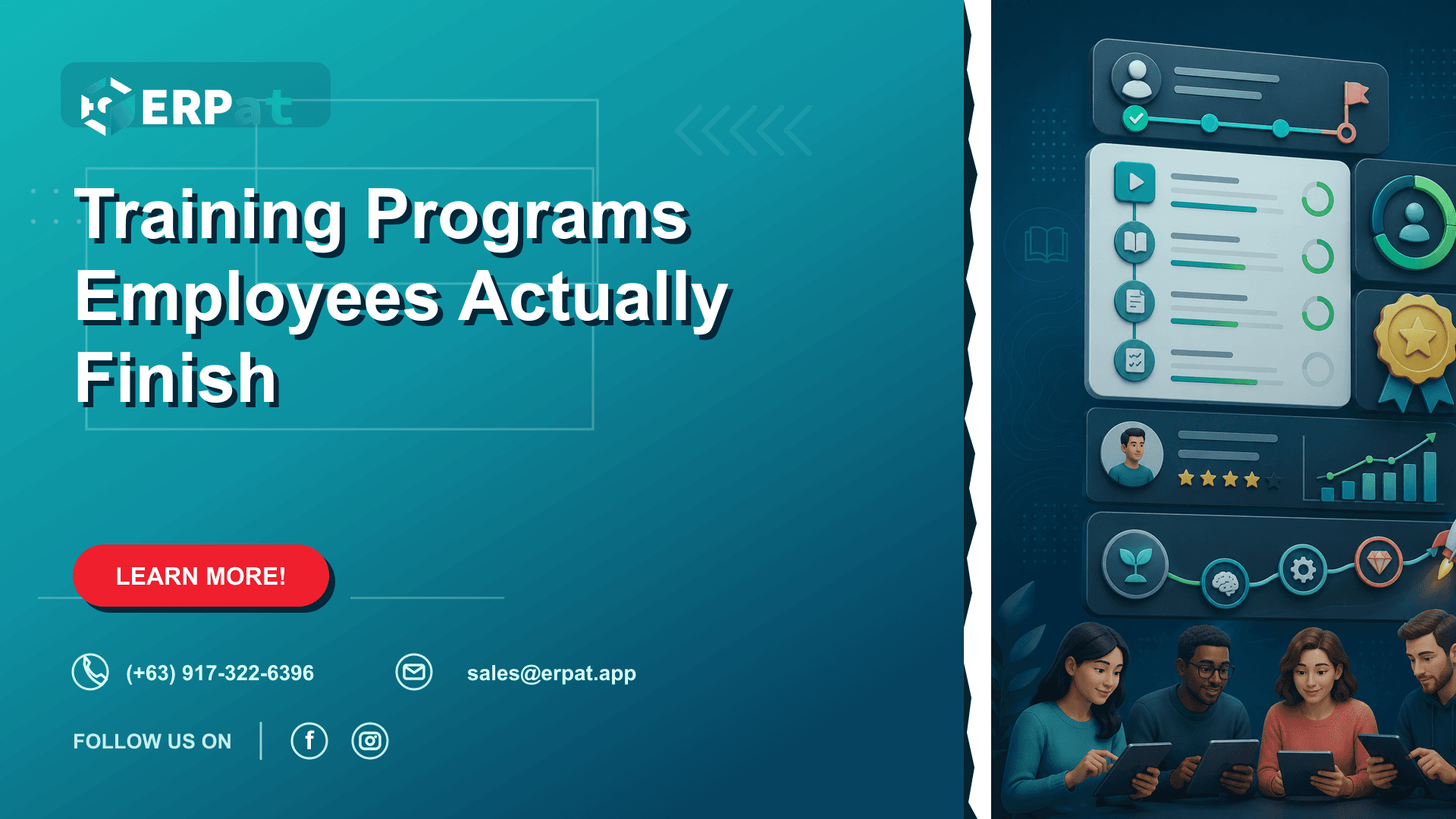
Training Programs Employees Actually Finish
Most training programs stall because nothing depends on finishing them. Here is how to build courses, tracks and certifications around what each role genuinely has to do.
In this guide
What to watch for
Use the article to identify repeat work, handoff gaps and places where one source of truth would help.
In this article
Almost every company has run training that nobody finished. The material exists, the schedule went out, most of the team showed up to the first session, and six months later nobody can say who is actually qualified to do what. The problem is rarely the content. It is that the training was never attached to anything the employee needed — a role requirement, a clearance, a task they are not allowed to perform alone until they have been through it.
Training fails when nothing depends on it
The usual pattern is a catalogue. Someone assembles a list of courses that look useful — customer handling, time management, a refresher on the accounting system — schedules them, and tracks attendance. Attendance is strong for the first session because the invitation came from management. It falls away after that, because nothing in anyone's week changes based on whether they finish.
Employees triage their time the way everyone does: by consequence. A course that exists because it is generally good practice will always lose to a cutoff deadline, a client follow-up or a stock count. That is not a motivation problem, it is a design problem. If completing a track does not change what a person is allowed to do, what they are measured on, or what their next role looks like, the training is optional in practice no matter how it is announced. The programs that get finished are the ones where finishing is load-bearing.
Start from what the role must be able to do
Before choosing any course, write down for each role what the person must be able to do without supervision, what still needs a second pair of eyes, and what they should not touch yet. A payroll officer's list might include running a full cutoff end to end, computing final pay for a resigning employee, and preparing the SSS, PhilHealth and Pag-IBIG remittances on time. An accounts officer's list looks nothing like it. The list belongs to the job, not to the department.
Build it with the person who currently does the job well, not from a generic competency template. Ask three questions: what did you have to learn the hard way in your first six months, what do people still come to you for, and what breaks when you are on leave. Those answers produce a more honest requirement list than any framework, and they surface the knowledge that is currently sitting in one person's head with no copy anywhere.
Then map who already meets each requirement. The gaps are your course list, and it is usually shorter than expected.
Sequence courses into tracks with a visible end
A course is a unit of content. A track is an ordered set of them with a defined completion point, and the track is what people actually finish. ERPat's Learn module is organised this way — courses, training tracks and certifications rather than a flat library — because an employee who opens a library of thirty unrelated items does not know where to start, and usually does not start.
Keep individual courses short enough to finish in one sitting between other work. Six twenty-minute courses get completed far more reliably than two half-day sessions, partly because short courses survive interruption: someone pulled into an urgent deadline loses one course, not a whole day. Put them in the order the job is actually learned — the daily task before the monthly one, the monthly before the annual exception.
And publish the finish line. "Six courses, then you can run the cutoff with a reviewer" is something a person can complete. "Ongoing professional development" is not.
Certification is what gives a track teeth
A certification here is not a printed document. It is a record that a named person completed a named track on a specific date, held alongside the rest of their employee record. That record answers questions that are otherwise answered from memory: who can cover payroll when the officer is on leave, who has been trained on the current approval process, who needs a refresher because that process changed.
It also makes cross-training visible, which is where smaller companies are quietly exposed. When one person is the only one who can close the books or run a cutoff, that is a business risk, not a staffing detail. A certification list turns "we should really train a backup" into a specific track with a name and a date against it.
A finished track proves someone went through the material, not that they can do the work under pressure. Pair the certification with supervised practice on real transactions before you treat it as clearance.
Let the scorecard carry the requirement
If a certification genuinely gates part of a job, it should appear in how performance is measured, not only in a training report. ERPat's KPI Matrix weights metrics by role, rolls individual scorecards into a team matrix, and turns those scores into salary recommendations. That is the loop that makes training non-optional: the requirement is defined at the role level, a track satisfies it, and the scorecard is where it shows up.
Be careful with the weighting. Training completion is an input, not an outcome, and a scorecard that leans too hard on inputs simply teaches people to click through content. Give it enough weight to be noticed and not so much that finishing courses beats doing the work well. Where you can, weight the outcome the training was meant to improve — fewer corrections after a cutoff, faster turnaround on a request — and treat the certification as the entry requirement rather than the score itself.
Build the onboarding track first
If you only build one track this year, build the one every new hire needs. Onboarding is the most repeated training in any company and usually the least documented. It happens by shadowing, and its quality depends entirely on how busy the person being shadowed was that week.
A structured onboarding track fixes the inconsistency: company orientation, the policies that apply from day one, the systems the person will use, and the first tasks they will own. You write it once and it runs for every hire after that. It also gives a manager something concrete to check at the end of week two instead of asking whether the new person seems to be settling in.
After onboarding, pick the role where an unplanned absence would hurt the most and give it one requirement list, one track, one certification and one trained backup. Watch whether it actually gets finished, then build the second. A training program assembled role by role stays small enough to maintain — and small enough that the people going through it can see exactly why they are there.
HRIS implementation context
Use "Training Programs Employees Actually Finish" to improve the employee workflow
HRIS articles become more valuable when the team connects the idea to a real employee journey: hiring, onboarding, scheduling, requests, approvals, records, reporting and self-service.
Part 1Employee moments to map
Start with the everyday work employees and HR teams repeat. Those moments reveal where a system should reduce friction.
- Onboarding records, employee profile updates and document collection
- Attendance, schedules, leave filing and approval requests
- Payslip access, benefit questions and HR announcements
Part 2Adoption details that matter
A good HRIS rollout is part process design and part change management. People need clear ownership and a reason to trust the system.
- Assign owners for data cleanup, approvals and employee questions
- Train managers on approval behavior, not only button clicks
- Keep employee self-service simple enough for repeat monthly use
Part 3Measures to track after rollout
The goal is not just digitization. The goal is fewer delays, clearer records and less back-and-forth.
- Time to complete onboarding or profile updates
- Number of HR requests handled without manual follow-up
- Accuracy and completeness of employee records before payroll cutoff
Chelsea Cuevas
Content & Marketing Associate
Covers business growth, HR best practices, and the technology behind modern operations.