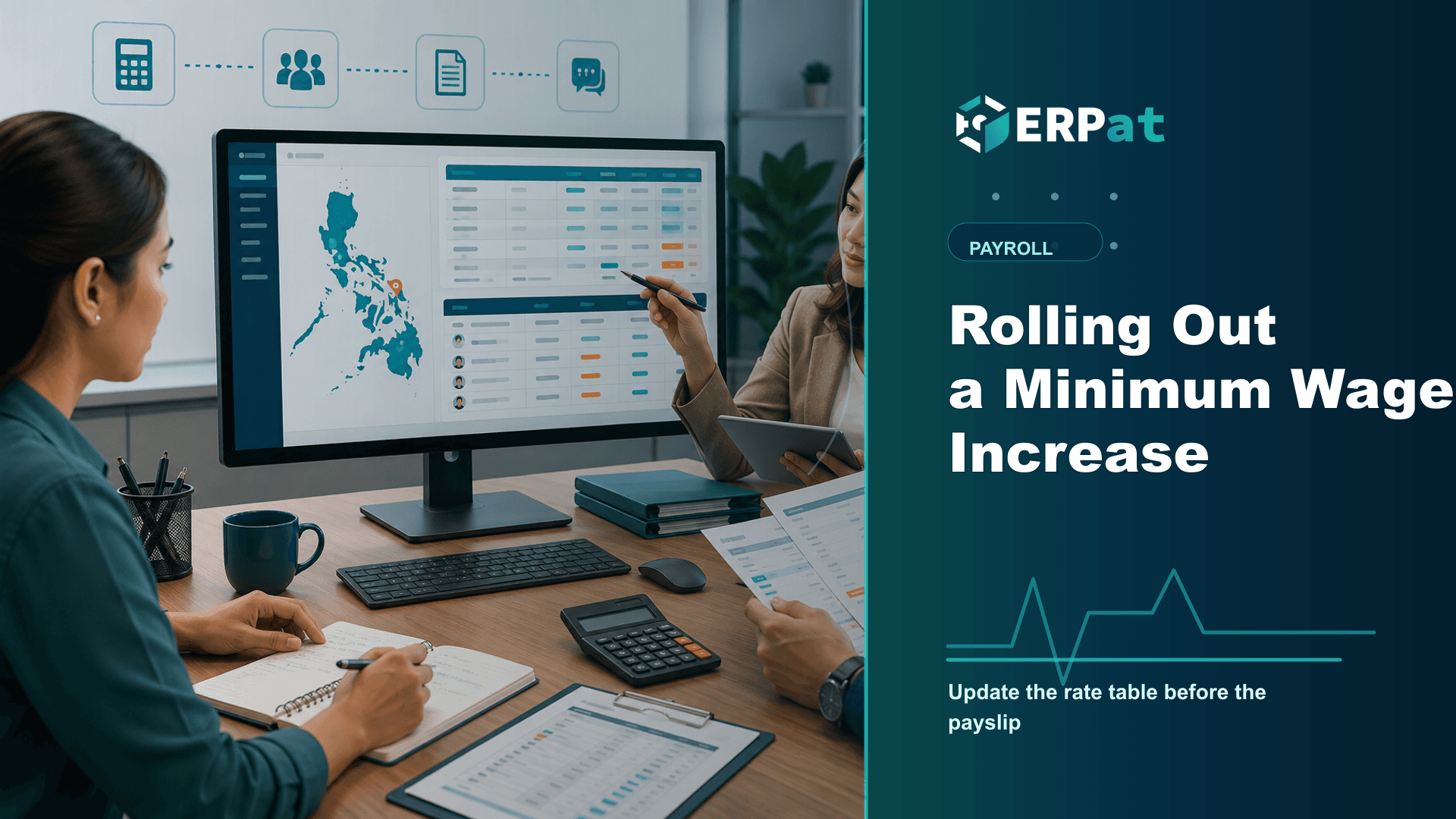

Minimum Wage Compliance: What Philippine Employers Should Know
A practical look at how the regional wage boards set the minimum wage, what a wage order actually obliges an employer to do, and how to roll a new daily rate through a live payroll without rebuilding it.
In this guide
What to watch for
Use the article to spot where payroll checks can be clearer, faster and easier to audit.

In this article
A wage order arrives with a fixed effective date and no interest in whether it lands mid-cutoff. Wage Order No. NCR-23 took effect on 04 June 2022 and raised the daily minimum wage in the National Capital Region by ₱33.00 — one number that quietly moves overtime, holiday pay, 13th month accrual and several contributions with it. Most employers get the headline rate right; the difficulty is everything downstream of it.
The minimum wage is set region by region
There is no single national minimum wage in the Philippines. Rates are fixed by the Regional Tripartite Wages and Productivity Boards under the National Wages and Productivity Commission, and each board issues wage orders covering only its own region. The BIR uses the same anchor: a minimum wage earner's exemption is tied to the statutory minimum wage fixed by the RTWPB or NWPC for the employee's place of assignment.
That last phrase is the one worth internalising. Run a head office in Metro Manila and a warehouse in another region and you are administering two wage floors, each with its own rate and categories. Employees are covered by the rate for where they work, not where payroll is processed — so the region belongs in the employee record, not in the memory of whoever runs payroll that month.
What a wage order actually obliges you to do
A wage order names an effective date, the region it covers, the increase, and the categories of establishment each rate applies to. From that date onward, no covered employee may be paid below the applicable floor.
NCR-23 illustrates the category structure clearly. It set the non-agriculture rate at ₱570.00 per day, and ₱533.00 per day for agriculture, for retail and service establishments employing 15 workers or fewer, and for manufacturing establishments regularly employing fewer than 10 workers. Two employers on the same street, both fully compliant, can be paying different daily minimums.
Paying monthly does not exempt you. The obligation is expressed as a daily rate, so a monthly-paid employee's compensation still has to resolve to at least the applicable daily minimum for the days they are required to work. An increase also compresses the gap between the new floor and those paid just above it, and that distortion is something the law expects an employer and its workers to settle rather than ignore.
Headcount thresholds are not interchangeable
Several obligations turn on how many workers you employ, and the thresholds are deliberately not the same. NCR-23 used 15 workers or fewer for retail and service, and fewer than 10 for manufacturing. Article 94 of the Labor Code exempts retail and service establishments regularly employing fewer than 10 workers from holiday pay, while Article 95 excludes establishments regularly employing fewer than 10 employees from service incentive leave.
Three rules, three slightly different tests. The common failure is deciding once that you are a small establishment and applying that answer everywhere: a retail business with 12 workers may sit in the lower wage-order category and still owe holiday pay and service incentive leave in full.
A payroll system applies whatever category you assign to an establishment; it cannot decide which one you belong to. Read the coverage section of the wage order itself, and confirm with your DOLE regional office before re-rating a whole group of employees.
Everything computed from the daily rate moves with it
A higher daily rate is never just one adjustment. Under Article 94, a covered worker is entitled to the regular daily wage during regular holidays and to twice the regular rate for work performed on one — both computed off the new rate from the effective date. Overtime and night shift differential are premiums on the basic rate, so they rise on their own.
Service incentive leave is the quieter one. Employees with at least a year of service get five days of paid leave annually, and under the Omnibus Rules it is commutable to its money equivalent if unused at year-end — at the rate in force when it is paid out, not the rate that applied when it was earned.
13th month pay follows too. Presidential Decree No. 851 defines it as one-twelfth of the basic salary earned within the calendar year, and Memorandum Order No. 28 removed the old salary ceiling so it covers all rank-and-file employees. A June increase raises the December figure on its own, provided the records after the effective date carry the corrected basic pay.
Contributions and withholding shift too
SSS contributions are computed on the Monthly Salary Credit. The schedule effective January 2021 sets the rate at 13% — 8.5% employer, 4.5% employee — over an MSC range of ₱3,000 to ₱25,000, so a raise can push an employee into the next bracket and change both shares. PhilHealth moves even more directly: the CY 2022 rate is 4.0% of monthly basic pay with a ₱10,000 floor and an ₱80,000 ceiling, shared equally, so any increase below the ceiling changes the premium at once. Pag-IBIG is the exception — its computation is capped at a monthly compensation of ₱5,000, where most employees already sit.
Withholding deserves a second look too. Minimum wage earners are exempt from income tax and withholding on their statutory minimum wage, and the exemption also covers holiday pay, overtime pay, night shift differential and hazard pay. Because that status is defined by the statutory minimum for the place of assignment, confirm who still qualifies rather than carrying last month's setting forward.
Rolling a new rate through a live payroll
Effective dates rarely line up with cutoffs. NCR-23 took effect on 04 June 2022, mid-period for most employers, and the correct treatment is to split the period: days worked before that date at the old rate, days from it onward at the new one. Averaging the two across the cutoff is the shortcut that quietly produces underpayment.
If implementation slips past the effective date, compute the differential and pay it as an identifiable payslip line rather than folding it into a lump sum. An employee should be able to see what was corrected and for which days, and so should an inspector reading that record later.
Keep the old rate, the new rate and the effective date on the employee record instead of overwriting one with the other. ERPat's Compensation module covers earnings, deductions, allowances and payslips and is fed straight from attendance, so once the daily rate is updated, the amounts derived from it follow from the same source data rather than a manual recomputation.
Before the next wage order
Wage orders are a recurring feature of running a business here, not a rare event. The employers who absorb them calmly can answer three questions on any given day: which region each employee works in, which category the establishment falls under, and who sits at or just above the floor. Keep those facts current in the employee record and the next order becomes a rate change with a date attached, not a reconstruction of three months of payroll.
Compliance context
Turn "Minimum Wage Compliance: What Philippine Employers Should Know" into a compliance checklist
Compliance-heavy articles are most useful when they become a repeatable review habit. Treat the guidance as a way to confirm evidence, ownership and timing before reports or payroll records are submitted.
Part 1Documents and records to prepare
Before the team reviews compliance requirements, make sure the supporting records are complete and traceable.
- Employee master records, pay history, schedules, leaves and attendance logs
- Contribution, tax, deduction and adjustment summaries
- Approval records, exception notes and revision history
Part 2Common gaps to prevent
Compliance gaps often come from missing evidence rather than missing intent. The system should make proof easy to find.
- Late updates to employee status, salary rates or tax/contribution details
- Manual corrections without a reason or reviewer attached
- Reports generated from data that does not match the approved payroll run
Part 3How to make review repeatable
Create a simple rhythm: prepare records, run checks, document exceptions, approve, then lock the final version.
- Use the same checklist every cutoff or reporting period
- Assign one owner for exceptions and one owner for final approval
- Keep final reports and supporting details together for later audit review
Jerome Evangelista
Content & Solutions Writer
Writes about payroll automation, HRIS, and how Philippine businesses run leaner with ERPat.