
Logistics and Delivery Tracking for Distributors
Deliveries go out, some come back, and the office finds out days later. Here is how distributors can keep dispatch, delivery and returns in one visible record instead of scattered across notebooks and chat threads.
In this guide
What to watch for
Use the article to identify repeat work, handoff gaps and places where one source of truth would help.
In this article
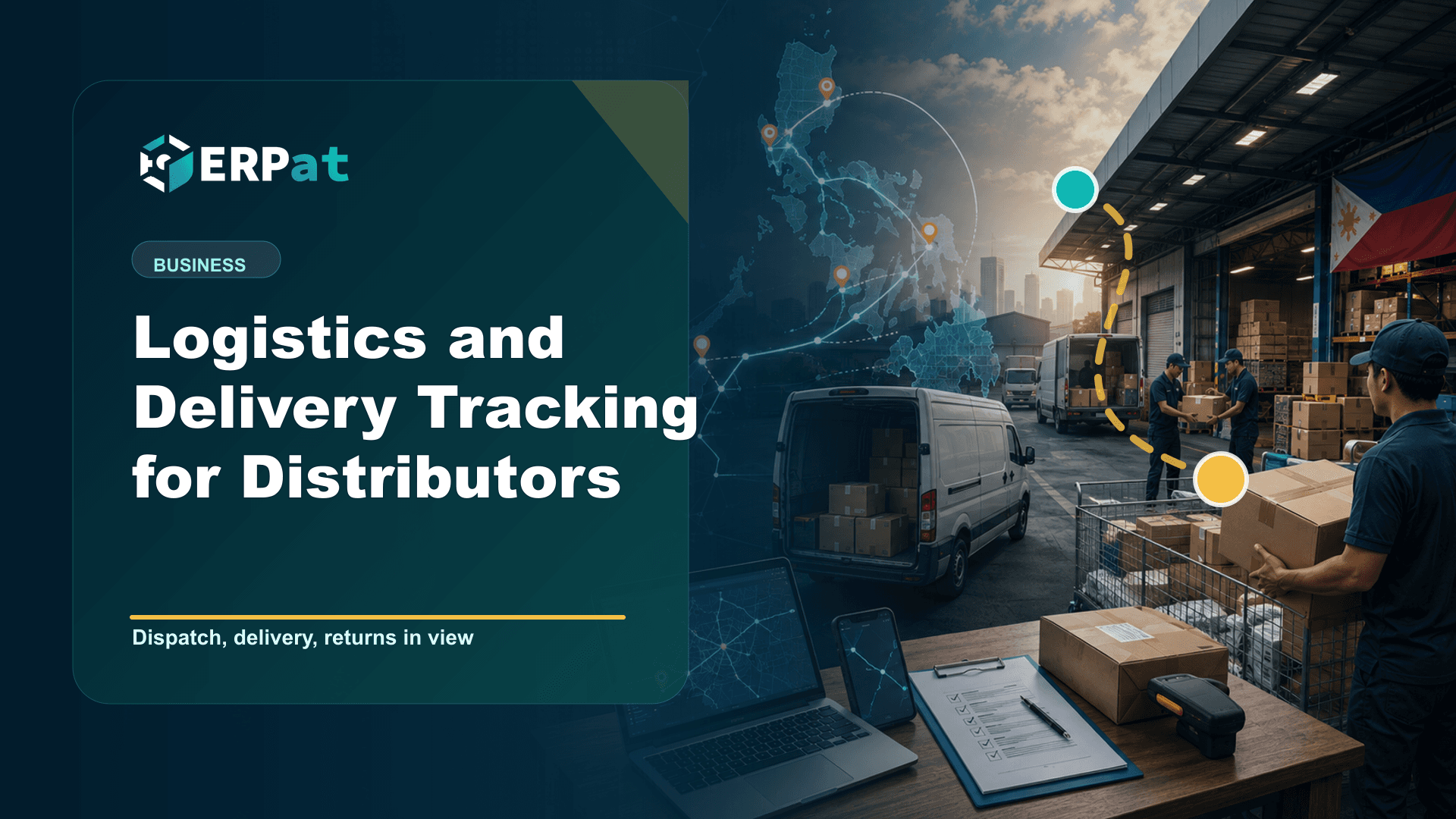
The hardest question in a distribution business is usually the simplest one to ask: where is that order right now? In a lot of companies the honest answer is that somebody has to call the driver, check a notebook at the guardhouse, and then call the warehouse to confirm what actually left. None of that is anyone's fault. It is what happens when dispatch, delivery and returns are recorded in three different places by three different people, and nothing joins them back together.
Where the visibility gap actually opens
Most distributors do not lose track of a delivery in transit. They lose it at the handoffs. An order is confirmed in the office, printed, and carried to the warehouse. The warehouse picks it, sometimes short, sometimes with a substitution, and writes the difference on the copy. The driver leaves with a stack of documents and comes back at the end of the day with the same stack, now annotated. Only then does anyone in the office learn that two of the eight stops did not go as planned.
Every one of those handoffs is a point where the record and the reality drift apart. The customer service staff quoting a delivery date does not know the item was short-picked. The accounting staff preparing the invoice does not know one carton was refused. The buyer looking at stock on hand does not know three cases are sitting in the returns area waiting to be inspected. The information exists — it is just trapped in the last person who touched it.
Dispatch is a decision, not a formality
Dispatch is where a distributor commits vehicles, people and stock to a plan for the day, and it deserves to be treated as a real decision rather than a stamp on a form. Before anything leaves the yard, someone should be able to see which orders are ready to go, which are waiting on stock, and which have already been assigned to a trip.
ERPat's Logistic module is built around exactly this: deliveries, dispatch, returns and supply movement across your fulfilment network, held in one place. When dispatch is recorded as its own step, a delivery stops being a piece of paper and becomes a record with a state — planned, dispatched, delivered, returned. That single change is what makes the rest possible. You can answer "what went out today" without walking to the warehouse, and you can tell the difference between an order that has not been prepared and one that is already on the road.
Following a delivery until someone signs for it
A delivery is not finished when the truck leaves. It is finished when the customer has the goods and someone has recorded what they actually received. The gap between those two moments is where distributors quietly bleed margin: short deliveries that are never billed correctly, refused items that stay on the books as sold, second trips made because nobody knew the first one failed.
Keeping the delivery record open until it is closed out properly forces that information back into the system. When the driver returns, the day's deliveries are reconciled against what was dispatched, and anything that did not land as planned is recorded against the specific order it belongs to — not as a general note that someone will sort out later. Over a few weeks this produces something most distributors have never had: a plain, factual history of which routes, which customers and which product lines consistently fail to complete on the first attempt. That is a scheduling problem you can act on, not a personality problem you argue about.
Returns deserve the same discipline as deliveries
Returns are the part of distribution that everyone underestimates, because they are irregular and inconvenient. Goods come back for a dozen reasons — wrong item, damaged in transit, over-ordered, refused at the gate, pulled for expiry — and each reason implies a different next step. Some stock goes straight back to sellable inventory. Some goes to a hold area. Some never sells again.
Treating returns as a tracked movement rather than an exception is what keeps the books honest. The Logistic module covers returns alongside deliveries and dispatch, which means a returned item is a recorded movement with an origin, not a mystery carton on the receiving dock. Recording the reason at the moment of receipt matters more than the paperwork that follows it, because reason codes are the only way to see a pattern. If one product line keeps coming back damaged, that is a packaging conversation with your supplier. If one customer keeps refusing deliveries, that is a commercial conversation with your sales team.
Stock accuracy is the other half of the problem
None of this works if your stock figures are wrong to begin with. A dispatch plan built on inventory that has not been reconciled since last month is a guess dressed up as a schedule, and the cost lands on the customer as a delivery that arrives short.
The Inventory module tracks stock levels, transfers and adjustments across every location, which is the foundation the Logistic module stands on. For distributors running more than one warehouse or holding consignment stock at a branch, per-location visibility is not a refinement — it is the difference between fulfilling an order from the nearest site and telling a customer you are out of stock while a pallet sits two towns away. Transfers between locations get recorded as movements too, so stock that is in motion is visible as in motion rather than disappearing from one branch and reappearing at another days later.
Delivery and returns tracking is only as accurate as the discipline behind it — if drivers and warehouse staff do not close out their records the same day, the reports will be confidently wrong. Decide who closes what, and by when, before you change anything else.
Where to start if you are still on paper
You do not need to redesign your whole operation to get most of this benefit. Start by making dispatch an explicit, recorded step, then insist that every delivery gets closed out with what was actually received. Add reason codes to returns once those two habits hold. Reconcile inventory per location so the plan is built on real numbers.
Distribution is a business of small margins and constant handoffs, and the companies that manage it well are rarely the ones with the newest trucks. They are the ones who can say, at any hour of the day, what left, what arrived and what came back — and who can answer that from a record rather than from memory.
Technology decision context
Use "Logistics and Delivery Tracking for Distributors" to make a better systems decision
Technology articles are most useful when they help the team decide what to change next. Focus on the process problem first, then choose the tool or integration that removes the most repeated work.
Part 1Start from the workflow, not the tool
A system change should solve a visible operational problem. Map who creates data, who reviews it and who depends on the result.
- Identify repeated encoding, manual exports and duplicate records
- Find handoffs that rely on reminders instead of system status
- Separate must-have controls from nice-to-have interface features
Part 2Integration details to check
A useful system should reduce context switching and make data easier to trust across teams.
- Which records need one source of truth?
- Which reports depend on data from more than one department?
- What permissions, audit logs and backups are required?
Part 3How to judge success
A better technology setup should improve speed, reliability and confidence in decisions.
- Fewer manual workarounds after rollout
- Shorter time from request to approval or report
- Clear ownership when something is missing or incorrect
Chelsea Cuevas
Content & Marketing Associate
Covers business growth, HR best practices, and the technology behind modern operations.