
Recruitment: Building a Better Hiring Pipeline
A hiring pipeline is a defined path from application to first day, with a named owner at every stage. Here is how to structure yours, run comparable interviews, and hand an accepted offer cleanly to onboarding.
In this guide
What to watch for
Use the article to identify repeat work, handoff gaps and places where one source of truth would help.
In this article
Most hiring problems do not look like hiring problems at first. A role sits open for months, the shortlist stays thin, and the one candidate everyone liked accepts an offer somewhere else while the panel is still comparing notes. Ask what went wrong and you rarely get a single answer: the resume was sitting in someone's inbox, the second interview was scheduled a week late, the offer waited on an approval nobody was chasing. The fix is almost never a better job ad. It is a pipeline — a defined path from application to first day that everyone involved can see.
Where hiring quietly breaks down
In most small and mid-sized Philippine companies, recruitment is not owned by one person doing one job. The HR officer is also handling timekeeping and government remittances. The hiring manager is running operations and reviewing resumes between shifts. The approver is whoever happens to be in the office. Nobody is neglecting the role; the role is simply competing with everything else on four people's desks.
That is why hiring loses time in the gaps rather than in the work. Screening a resume takes minutes. Waiting three days for someone to remember to screen it is what stretches a two-week process into two months. And because each handoff lives in a different place — an email thread, a chat group, a folder of attachments, a notebook of interview notes — no one can see where an applicant is stuck without asking around.
A pipeline is the cure for that specific problem. It does not make anyone work faster. It makes the waiting visible, which is usually enough.
Define the stages before you post the job
Write down the stages a candidate will pass through, and do it before the posting goes live rather than after the first applications arrive. For most roles, five or six stages are plenty: applied, HR screening, hiring manager review, a practical or technical assessment, final interview, and offer. Adding more stages does not make the process more rigorous; it just adds places to get stuck.
For each stage, agree on three things. Who owns it — one named person, not a department. What moves a candidate forward — the specific thing you are checking at that step, not a vague sense of fit. And how long it should take, expressed in working days. A screening stage with no time expectation will always take as long as the busiest week allows.
Agree on the salary band and the approval path at this point too. Deciding what you can pay while a candidate is waiting for an answer is how good applicants get lost, and it is entirely avoidable.
Keep every applicant in one shared record
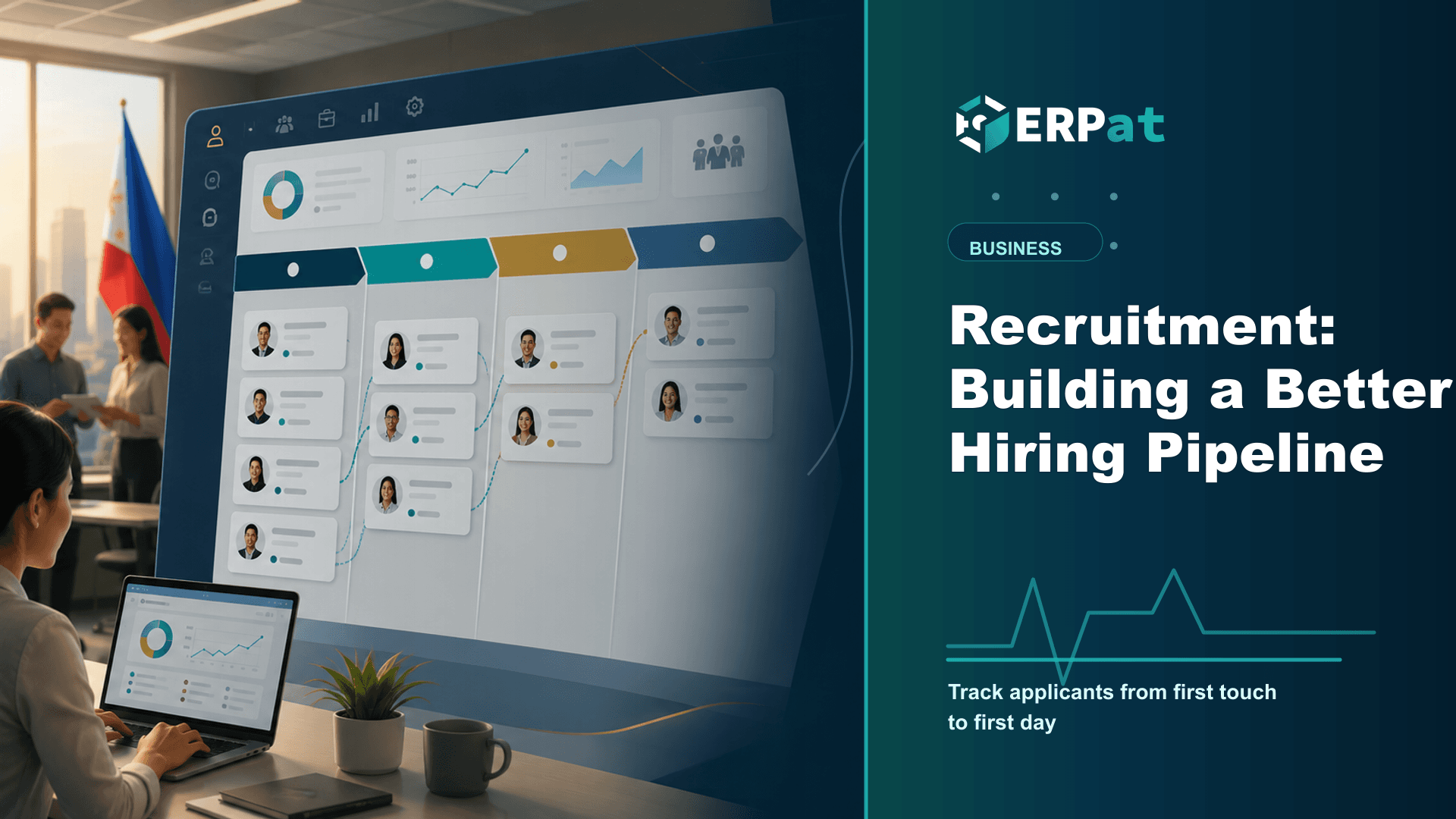
Once the stages exist, they need somewhere to live that is not an inbox. The Recruitment module in ERPat is built around this: job postings, applicant pipelines and interview stages run through to offer and onboarding in one place, so the current state of a role is something you look at rather than something you reconstruct.
The system will not decide who to hire. What it removes is the overhead of remembering — which is the part that fails first when the office gets busy.
Make interviews comparable, not just conversational
A pleasant interview and a useful one are different things. If each interviewer asks whatever comes to mind, you finish the week with four impressions that cannot be placed side by side, and the loudest opinion in the room wins by default.
Fix this by deciding, per role, on a small set of core questions every candidate answers, and on what a strong answer actually sounds like. Interviewers may still explore whatever they find interesting — the core set just guarantees there is common ground to compare. Ask about concrete past situations rather than hypotheticals: what the candidate was responsible for, what they actually did, and what happened as a result.
Then write the notes immediately, while the conversation is fresh, and keep observation separate from conclusion. "Walked through her month-end close process unprompted" is evidence. "Strong accountant" is a verdict. Recording the first makes the second defensible a week later, when three panelists are trying to remember which candidate said what.
Treat the offer as a stage, not an event
Offers fail for boring reasons. The number was never approved. The written offer took four days to draft. Nobody asked what else the candidate was considering, so the counteroffer from their current employer arrived unopposed.
Handle the offer the way you handle any other stage: with an owner, a time expectation and a clear next step. Make the verbal offer promptly, follow it with the written one quickly, and give the candidate a specific date to respond rather than leaving it open. Be direct about the compensation package, the schedule, the reporting line, and what the first months look like. Candidates who accept an offer they did not fully understand tend to leave early, which puts you back at the top of the pipeline.
Acceptance is also not the finish line. Between signing and starting, a new hire is serving out notice at another company and is entirely reachable by everyone else hiring. Keep in contact through that period. A short check-in and a clear picture of day one costs almost nothing and prevents the most expensive kind of drop-out.
Close the loop between offer and first day
The handoff from recruitment to onboarding is where otherwise good processes come apart. The applicant record ends, an employee record begins somewhere else, and the same details get collected twice — often from the new hire, on their first morning, which is not the impression you want to make.
Plan the handoff explicitly. Decide what has to be collected before day one: the pre-employment requirements your company asks for, the government numbers needed for SSS, PhilHealth, Pag-IBIG and BIR registration, and bank details for payroll. Decide who prepares the workspace, the equipment and the accounts. Decide who owns the first week's schedule, so the new hire is not left waiting for someone to be free.
Keeping recruitment and onboarding on the same platform helps here, because the information already gathered during hiring stays with the person instead of being re-encoded. The candidate becomes an employee without anyone starting a new file from scratch.
Reviewing the pipeline you built
A pipeline is worth having partly because it can be examined. Once your stages are consistent, look back every quarter at simple things: how long roles are taking, which stage holds candidates longest, where people drop out, and which sources bring the applicants you actually hire. Those answers point at one or two fixable steps, and fixing them beats redesigning the whole process. Hiring well is not a single good decision — it is a repeatable path that a busy team can follow without anyone having to remember it.
HRIS implementation context
Use "Recruitment: Building a Better Hiring Pipeline" to improve the employee workflow
HRIS articles become more valuable when the team connects the idea to a real employee journey: hiring, onboarding, scheduling, requests, approvals, records, reporting and self-service.
Part 1Employee moments to map
Start with the everyday work employees and HR teams repeat. Those moments reveal where a system should reduce friction.
- Onboarding records, employee profile updates and document collection
- Attendance, schedules, leave filing and approval requests
- Payslip access, benefit questions and HR announcements
Part 2Adoption details that matter
A good HRIS rollout is part process design and part change management. People need clear ownership and a reason to trust the system.
- Assign owners for data cleanup, approvals and employee questions
- Train managers on approval behavior, not only button clicks
- Keep employee self-service simple enough for repeat monthly use
Part 3Measures to track after rollout
The goal is not just digitization. The goal is fewer delays, clearer records and less back-and-forth.
- Time to complete onboarding or profile updates
- Number of HR requests handled without manual follow-up
- Accuracy and completeness of employee records before payroll cutoff
Jerome Evangelista
Content & Solutions Writer
Writes about payroll automation, HRIS, and how Philippine businesses run leaner with ERPat.