
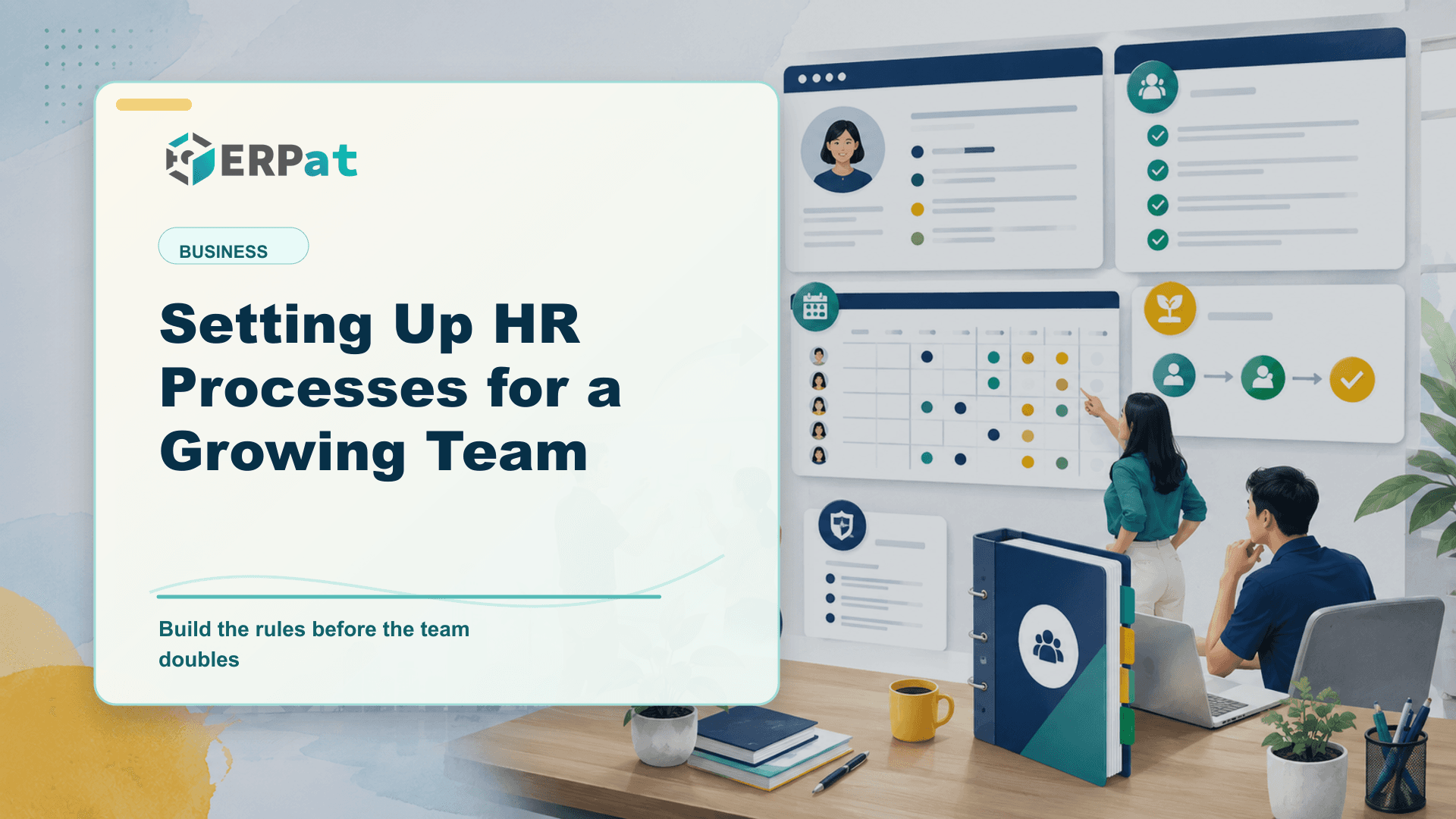
Setting Up HR Processes for a Growing Team
Informal HR works until it does not. This guide walks through the first processes a growing Philippine company should formalise — employee records, schedules, leave, hiring and onboarding — and the order to tackle them in.
In this guide
What to watch for
Use the article to identify repeat work, handoff gaps and places where one source of truth would help.
In this article
There is a point in every growing company where HR stops being something the owner handles between meetings. It arrives quietly: a leave request nobody logged, a new hire who started before the contract was signed, a payroll cut-off missed because the schedule lived in one person's head. The arrangements that carried you from five staff to fifteen rarely survive the trip to twenty-five. What follows is the order worth formalising them in.
What actually breaks at around twenty people
Informal HR is efficient, right up until it is not. It works because one person holds all the context: who is on leave, who is owed an adjustment, what was promised at hiring. That has a hard ceiling. Once nobody can hold every arrangement in memory, each undocumented exception becomes a dispute waiting to happen and answers have to be reconstructed from chat threads.
Headcount also changes what the law asks of you. Several exemptions in Philippine labor and social legislation are written around the number ten. Establishments regularly employing fewer than ten employees are excused from the five-day service incentive leave under Article 95 of the Labor Code; retail and service establishments with fewer than ten workers are exempt from holiday pay under Article 94; and Pag-IBIG has required employers with at least ten employees to remit electronically since July 2016. Cross those thresholds and obligations you never carried start applying, without anyone sending you a notice.
Build one employee record before anything else
Every other process depends on knowing, without argument, who works here and under what terms. Long before you buy software, consolidate the employee record: personal details, employment dates, position, schedule, pay basis, government numbers, leave entitlements and the supporting documents. One record, one owner, one place.
This is what the Human Resource module is built around: employee profiles, schedules, attendance, leaves and holidays in one place rather than scattered across a payroll file, a leave spreadsheet and a folder of scanned IDs. The payoff is not storage. It is that a leave balance and an attendance record can no longer disagree, because there is only one of each.
Treat that file as sensitive from day one. Under National Privacy Commission Circular No. 16-03, a personal information controller must notify the Commission within seventy-two hours of knowing, or reasonably believing, that a personal data breach has occurred. Decide who can see salary, who can see medical information, and who can see only a schedule.
Put schedules and attendance in writing
Schedules look like an operations concern and behave like a legal one. The assigned schedule determines whether an hour is regular work or overtime, whether a holiday was worked or merely observed, and how a half-day of leave is deducted. When schedules are informal, everything computed from them is contestable.
Write the rules down before you automate them: the standard shifts, how a shift change is approved, the attendance cut-off for each payroll period, and how tardiness, undertime and unrecorded absences are treated. Two paragraphs of clear policy will do more than any biometric device.
Because the Human Resource module keeps schedules, attendance and the holiday calendar alongside the employee profile, a dispute is settled by reading one history instead of reconciling three. The goal is not surveillance; it is that when someone asks why a payslip looks the way it does, you answer with a record rather than an opinion.
Turn leave into a policy with a paper trail
Leave is where informal HR fails most visibly, because it mixes entitlement, memory and money. Start from the statutory floor: Article 95 of the Labor Code gives every employee with at least one year of service five days of paid service incentive leave a year, commutable to cash under the Omnibus Rules if it is not used by year's end. Anything above that floor is a policy decision and should be written as one, with accrual rules and an approval path.
Maternity leave deserves its own handling. Under RA 11210 a covered employee is entitled to 105 days of leave with full pay for live childbirth, and the employer must advance the full payment within thirty days of the filing of the application.
SSS reimburses the employer only up to 100% of the member's average daily salary credit, which is the cash benefit component rather than the employee's full pay. The difference is borne by the employer unless it qualifies for an exemption under the law's implementing rules, such as a retail or service establishment regularly employing not more than ten workers, which has to be applied for with DOLE annually.
Keep balances in the system that holds attendance and the two stop contradicting each other. Note also DOLE Labor Advisory No. 01, series of 2022, issued this month, which urges but does not require private employers to adopt a paid isolation and quarantine leave program on top of existing benefits.
Make hiring a pipeline instead of a favor
Below twenty staff, hiring is episodic and referral-driven. Past it you are almost always recruiting for something, and the failure modes change: applicants wait days for a reply, two managers interview the same candidate without knowing, and nobody can explain why the last three hires were chosen.
Structure fixes this better than effort does. Define the stages a candidate passes through, who owns each one, and what has to be true before anyone moves forward. The Recruitment module runs job postings, applicant pipelines and interview stages through to offer and onboarding, so the history of a hire — where they came from, who spoke to them, what was agreed — sits in the same platform as the employee record they eventually become.
Continuity matters here: whoever onboards a new hire should not be reading a different set of notes than the person who interviewed them.
Write down onboarding and offboarding
The two ends of employment are where undocumented process costs the most, and both are deadline-bound. Onboarding should be a literal checklist: signed contract, assigned schedule, registration or reporting to SSS, PhilHealth, Pag-IBIG and the BIR, enrolment in the payroll run, orientation on attendance and leave rules, and system access. Written once, it survives different managers running it.
Offboarding needs the same discipline in reverse: returned property, revoked access, clearance, final pay, and the certificates the employee is owed. Note the timing on one of those. BIR Form 2316 must be furnished on or before January 31 of the following year, or on the day the last payment of compensation is made if employment ends earlier, so a resignation in June carries a certificate obligation in June rather than next January. Keep both checklists wherever the employee record lives, so that completing a step updates the record instead of an email thread.
Decide what to formalise first
You do not need all of this by the end of the quarter. If you formalise one thing, make it the employee record: attendance, leave, payroll and hiring all read from it, and none of them can be trusted while it is scattered. Schedules and leave come next, since those are where a missing document turns into a disagreement about money. Hiring and onboarding follow once the foundation holds. The aim is not bureaucracy but this: a fair question about someone's employment takes a minute to answer, and gets the same answer whoever is asked.
HRIS implementation context
Use "Setting Up HR Processes for a Growing Team" to improve the employee workflow
HRIS articles become more valuable when the team connects the idea to a real employee journey: hiring, onboarding, scheduling, requests, approvals, records, reporting and self-service.
Part 1Employee moments to map
Start with the everyday work employees and HR teams repeat. Those moments reveal where a system should reduce friction.
- Onboarding records, employee profile updates and document collection
- Attendance, schedules, leave filing and approval requests
- Payslip access, benefit questions and HR announcements
Part 2Adoption details that matter
A good HRIS rollout is part process design and part change management. People need clear ownership and a reason to trust the system.
- Assign owners for data cleanup, approvals and employee questions
- Train managers on approval behavior, not only button clicks
- Keep employee self-service simple enough for repeat monthly use
Part 3Measures to track after rollout
The goal is not just digitization. The goal is fewer delays, clearer records and less back-and-forth.
- Time to complete onboarding or profile updates
- Number of HR requests handled without manual follow-up
- Accuracy and completeness of employee records before payroll cutoff
Chelsea Cuevas
Content & Marketing Associate
Covers business growth, HR best practices, and the technology behind modern operations.