
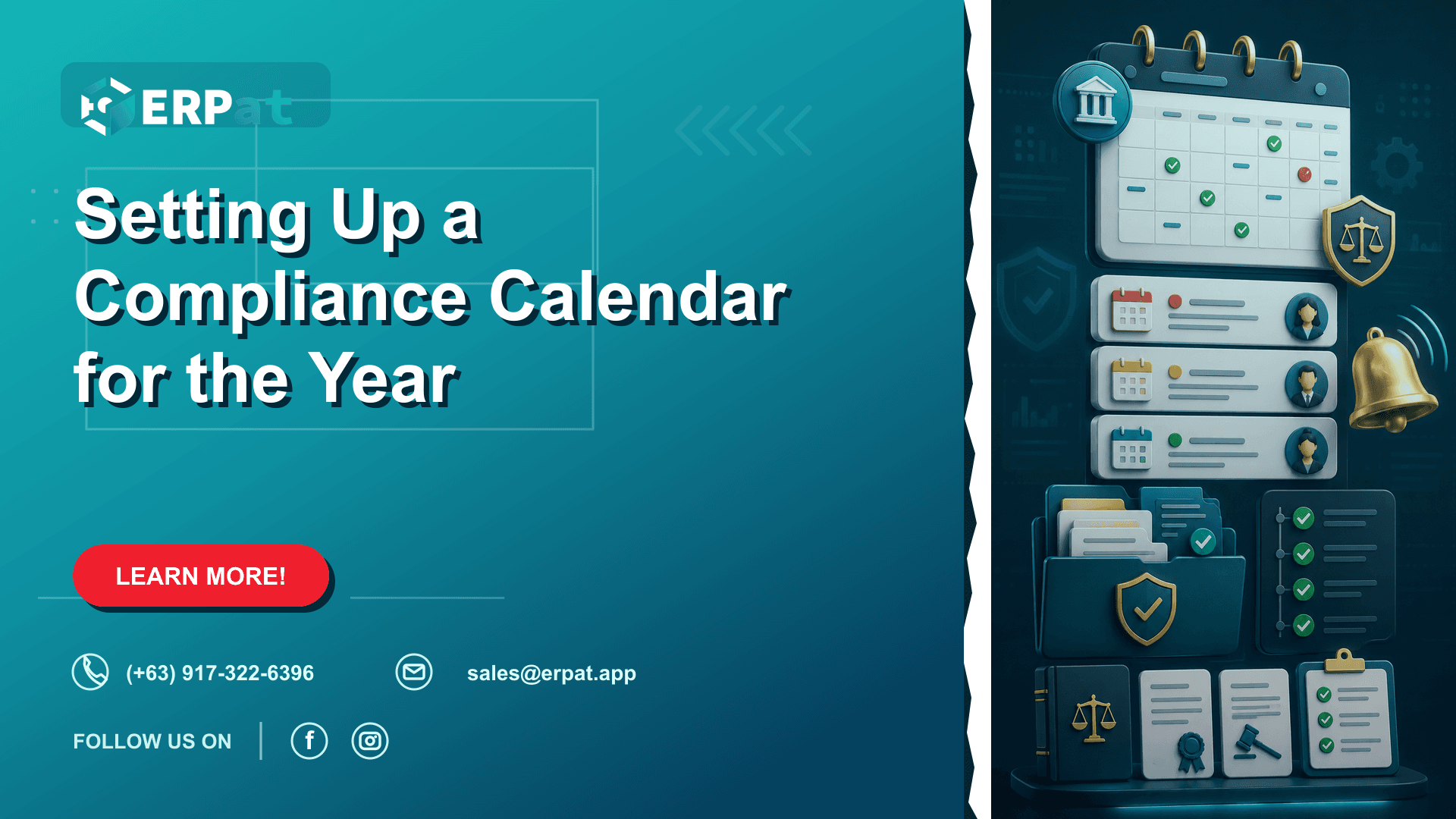
Setting Up a Compliance Calendar for the Year
A practical method for turning the year's recurring statutory duties into dated tasks with named owners. Covers the fixed deadlines, the prep work behind each one, and how to keep the evidence with the date.
In this guide
What to watch for
Use the article to identify repeat work, handoff gaps and places where one source of truth would help.
In this article
January is when the compliance year is quietly decided. The deadlines are already fixed — most of them were fixed decades ago — and none of them will move because payroll was busy, the accountant was on leave, or the person who used to prepare the alphalist has resigned. Yet in most small and mid-sized companies the schedule lives in one person's memory and a folder of last year's forms. A compliance calendar is the cheapest fix available: it turns obligations you already owe into dated, assigned, visible work.
Why a calendar beats a checklist
A checklist tells you what is owed. A calendar tells you when it is owed and who is doing it, and those are the two facts that actually determine whether you pay a penalty. Statutory penalties are computed by date arithmetic, not by intent. An employer that fails to remit Pag-IBIG contributions is subject to a penalty of three percent per month of the amounts payable, running from the date they fall due until paid. Missed PhilHealth premiums must be settled with interest compounded monthly of at least three percent for employers. Late SSS payments attract penalties as well.
None of these processes ask why you were late. That is what makes the calendar the right unit of control: it moves the work upstream of the deadline, where it is still cheap to fix. A missed January date costs money in February and shows up again during an audit years later, long after everyone has forgotten the reason.
Lay down the fixed dates first
Begin with the obligations that repeat on a known cycle, because they are the backbone of the year. Monthly, that means the contribution remittances and the withholding remittance. Regular business employers must remit SSS contributions by the last day of the month following the applicable month. Pag-IBIG remittances go through a Fund-accredited electronic payment and collection facility, which all employers have been required to use since HDMF Circular No. 355 took full effect. PhilHealth premiums follow their own posted schedule.
Then place the annual anchors. On or before January 31, every employer must furnish each employee from whom taxes were withheld their BIR Form No. 2316, and must file BIR Form No. 1604-C together with the alphalists of employees. In cases covered by substituted filing, duplicate copies of Form 2316 go to the BIR not later than February 28, along with the Certified List of Employees Qualified for Substituted Filing. Individual income tax returns are due on or before April 15. And at the far end of the year, 13th month pay must reach all rank-and-file employees not later than December 24.
Give every date an owner and a date before the date
An entry with no name attached is a wish. Every line on the calendar needs a named owner, a named backup, and — this is the part usually missing — an earlier internal milestone that represents the real work. The February 28 submission is not a February task. It depends on the December payroll register being final, reconciled and free of adjustments, which means the true deadline sits in early January.
Work backwards from each statutory date and put the preparation on the calendar as its own entry. Thirteenth month pay is due December 24, so the computation, the review of basic salary within the calendar year, and the funding request belong in November. Service incentive leave is commutable to its money equivalent if it is not used or exhausted at the end of the year, so the leave-balance reconciliation is a November or early-December task, not a December 23 surprise. Owners should be individuals, not departments; "Finance" has never once filed a return.
Dates move, and rules move more
Two things shift under a calendar. First, the dates themselves: if an SSS payment deadline falls on a Saturday, Sunday or holiday, payment may be made on the next working day — useful to know, and worth annotating so nobody panics or, worse, assumes the same latitude applies everywhere.
Second, and more consequential, the underlying rules change while the dates stay put. The PhilHealth premium rate for 2024 is 5.00%, with a ₱10,000 income floor and a ₱100,000 income ceiling. Pag-IBIG Fund Circular No. 460, dated 15 January 2024, sets out the Fund's implementation of an increase in the maximum fund salary effective February 2024. The Social Security Act itself schedules the next step in the contribution ladder for 2025. So the calendar needs one more recurring entry that has no statutory deadline at all: a standing review of new circulars and advisories, early in each quarter, owned by someone specific.
Scheduling a remittance guarantees only that it is filed on time, not that it is computed correctly — an entry still pointing at last year's schedule will be punctual and short. Pair every recurring entry with a check that the rate, floor and ceiling actually applied in the payroll run are the ones in force for that month.
Keep the evidence beside the date
A deadline met without a record is difficult to prove later, and proof is what an examination actually asks for. The Compliance module in ERPat is built for this half of the problem: policy tracking, audit trails and the documentation regulators ask for, held against the obligation rather than scattered across inboxes. When the calendar entry, the approval, the filed form and the proof of payment sit together, reconstructing a period takes minutes instead of days.
Retention deserves its own entries. An employer implementing telecommuting, for instance, must keep the documents proving voluntary adoption for at least three years, and must notify DOLE through the Establishment Report System. Note too that not every duty is calendar-driven: a personal data breach must be reported to the National Privacy Commission within seventy-two hours of knowledge or reasonable belief. Event-triggered obligations belong in the same register, flagged as such, so the team knows the clock starts on discovery rather than on a date.
Make the calendar visible to the people who feed it
Most compliance failures are upstream data failures. The alphalist is late because a December adjustment was late; the remittance is short because a new hire's details were not encoded. So the calendar cannot live only with the person who files. Payroll cut-offs, leave-filing windows, document deadlines for new hires and the dates when a changed rate first applies all need to reach line managers and staff before they matter.
The Events module handles the announcement side, with schedules, invitations and attendance for company events and advisories. A short briefing when a contribution schedule changes, recorded with who attended, is both a practical control and a piece of evidence. The point is not ceremony — it is that a date nobody outside Finance can see is a date only Finance can protect.
Build one year, then keep it
Set the calendar up once, honestly, and it becomes an asset that survives resignations. Start with a single sheet: every recurring obligation, its statutory date, its internal prep date, its owner, its backup, and where the evidence goes. Move it into whatever system your team already opens daily, then review it each quarter against new issuances. The work does not get smaller — the contributions, the returns and the year-end benefits are all still owed — but it stops arriving as a surprise, and that is most of what a good compliance year actually is.
Compliance context
Turn "Setting Up a Compliance Calendar for the Year" into a compliance checklist
Compliance-heavy articles are most useful when they become a repeatable review habit. Treat the guidance as a way to confirm evidence, ownership and timing before reports or payroll records are submitted.
Part 1Documents and records to prepare
Before the team reviews compliance requirements, make sure the supporting records are complete and traceable.
- Employee master records, pay history, schedules, leaves and attendance logs
- Contribution, tax, deduction and adjustment summaries
- Approval records, exception notes and revision history
Part 2Common gaps to prevent
Compliance gaps often come from missing evidence rather than missing intent. The system should make proof easy to find.
- Late updates to employee status, salary rates or tax/contribution details
- Manual corrections without a reason or reviewer attached
- Reports generated from data that does not match the approved payroll run
Part 3How to make review repeatable
Create a simple rhythm: prepare records, run checks, document exceptions, approve, then lock the final version.
- Use the same checklist every cutoff or reporting period
- Assign one owner for exceptions and one owner for final approval
- Keep final reports and supporting details together for later audit review
Chelsea Cuevas
Content & Marketing Associate
Covers business growth, HR best practices, and the technology behind modern operations.