
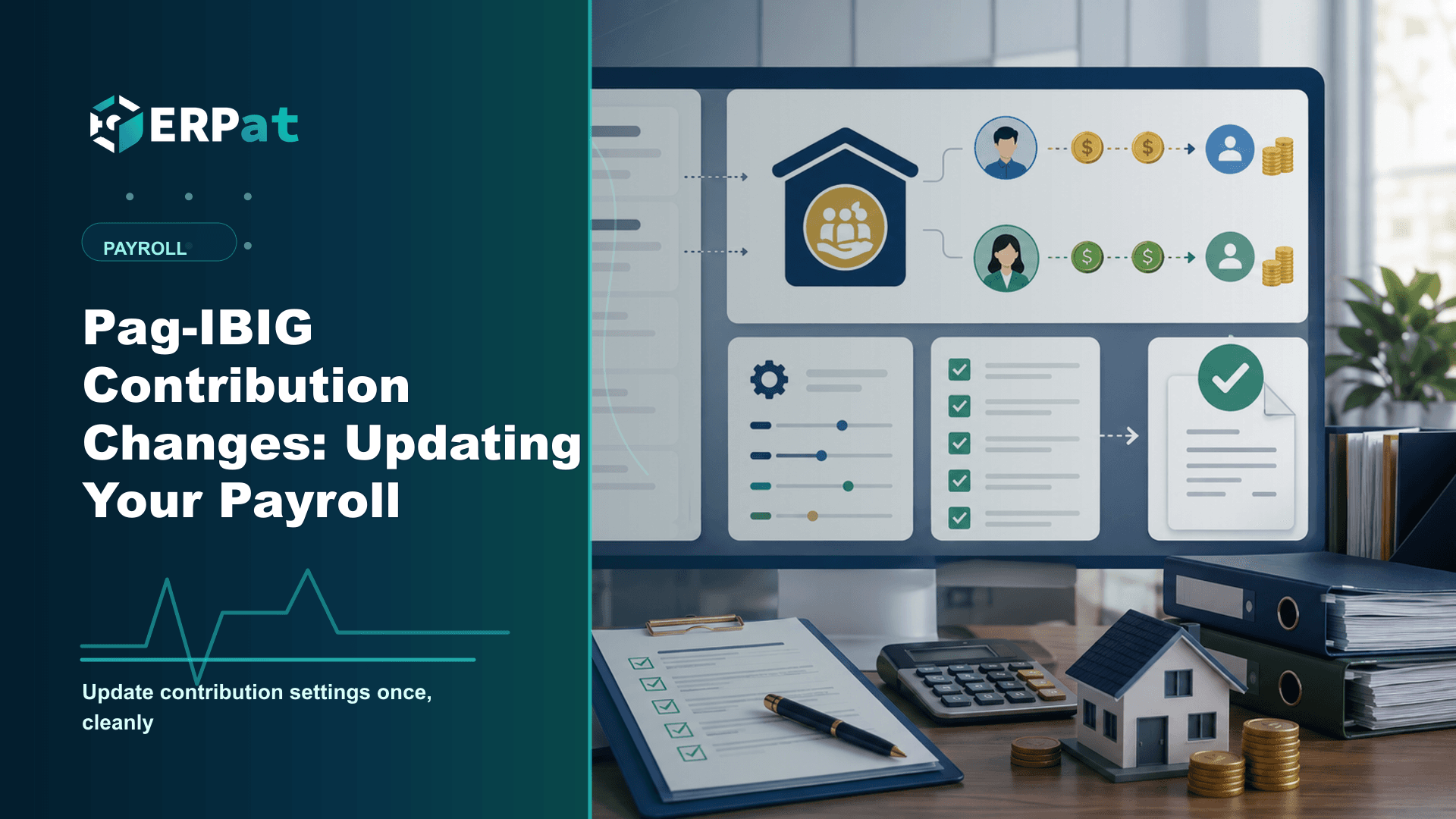
Pag-IBIG Contribution Changes: Updating Your Payroll
Pag-IBIG's maximum fund salary doubled effective February 2024, and the percentage rates did not move at all. Here is what that changes in your deduction setup, and what to check before your first affected run.
In this guide
What to watch for
Use the article to spot where payroll checks can be clearer, faster and easier to audit.
In this article
Every payroll officer carries a mental model of what a Pag-IBIG deduction looks like, and for most of the last decade that model was simple: a small percentage, capped, the same quiet line item every month. As of this month it is no longer accurate. Pag-IBIG Fund Circular No. 460, issued in Makati City on 15 January 2024, doubled the maximum fund salary used to compute member and employer savings, effective for the February 2024 contribution period. The rule is one sentence long; the payroll work behind it is not.
What Circular No. 460 actually changed
The most common misreading of this change is that the contribution rate went up. It did not. Circular No. 460 moved the maximum fund salary — the ceiling on the compensation figure the percentages are applied to — from ₱5,000 to ₱10,000, and left the rates exactly where Republic Act No. 9679 put them. Employees earning not more than ₱1,500 a month still contribute 1%, employees earning more than ₱1,500 still contribute 2%, and employers still contribute 2% of the monthly compensation of every covered employee.
Because only the ceiling moved, the peso effect is pure arithmetic. From January 2021 through January 2024 the ₱5,000 cap held the member share to a maximum of ₱100 and the employer counterpart to a matching ₱100 — ₱200 in total. From the February 2024 contribution period those maximums are ₱200 each, for ₱400 in total. Section 7 of RA 9679 always allowed this: it set the original ₱5,000 figure and expressly empowered the Board of Trustees to change that maximum by rules and regulations.
Who on your payroll is actually affected
It is tempting to treat a ceiling increase as a high-earner problem. It is not. The employees whose deduction changes are everyone whose fund salary sits above the old ₱5,000 cap, which in most Philippine companies means nearly the entire payroll.
Work through three cases. An employee with a fund salary of ₱4,000 sees no change at all — 2% of ₱4,000 was ₱80 before and remains ₱80. An employee at ₱8,000 was previously computed on a base capped at ₱5,000, giving ₱100; from February the base is the full ₱8,000, so the member share becomes ₱160 and the employer counterpart the same. Anyone at ₱10,000 or above is computed on ₱10,000 either way and lands on the new maximum of ₱200 per side.
The consequence is that net pay falls for most of your staff in the same run, and the employer's monthly counterpart cost rises alongside it. Both are worth announcing before the payslip does the announcing for you.
Getting the fund salary base right
This is where a reconfiguration most often goes wrong, and it is a subtler problem than the ceiling itself. Circular No. 460 defines Fund Salary as the basic salary and other allowances, with basic salary covering fees, salaries, wages and similar items received in a month.
While the cap sat at ₱5,000, that definition rarely mattered in practice. Almost every full-time employee was already above the ceiling, so whatever your system fed into the computation, the answer came out the same. With the ceiling at ₱10,000, the composition of the base now decides the answer for a much larger part of the workforce, and a mapping that was harmlessly wrong for years can start producing under-remittances.
So audit the mapping, not just the cap. Open the deduction setup, confirm exactly which earnings and allowance components flow into the Pag-IBIG base, then check the result by hand against a few real employees across the salary range rather than assuming an inherited configuration is still fit for purpose.
The employer counterpart is not recoverable
The 2% employer counterpart deserves its own line in the budget conversation, because it is genuinely the employer's money. Pag-IBIG requires employers to remit 2% of the contributing member's monthly fund salary as counterpart contribution, and employers are legally barred from deducting or recovering that share from the employee. There is no lawful arrangement in which a doubled ceiling gets passed back to staff.
A related question tends to surface as soon as employees notice the change: can they save more? They can — members may contribute more than the required amount. But the employer is only obliged to match up to the mandated rate unless it agrees to match the higher figure. Decide your position on that in advance and put it in writing, because answering it inconsistently across a payroll is much harder to unwind than answering it once.
The remittance file matters as much as the deduction
Computing the right amount is only half the obligation. RA 9679 does not itself fix a remittance deadline — Section 23(a) makes it the duty of every employer to set aside and remit contributions in accordance with a mechanism determined by the Board of Trustees, and Section 23(b) attaches a penalty of 3% per month of the amounts payable, running from the date they fall due until they are paid.
The channel is prescribed too. HDMF Circular No. 355 requires employers to remit premium contributions and employee loan repayments through a Pag-IBIG-accredited electronic payment and collection facility, a requirement that has applied to employers with at least ten employees since 31 July 2016. If your payroll exports a contribution file, that export has to carry the new figures as well — a corrected deduction that reaches the Fund as a stale total is still a problem.
The higher maximum fund salary applies to contributions for the period February 2024 onwards. A January 2024 contribution that you happen to remit during February is still computed on the old ₱5,000 ceiling.
Members who are not standard employees
Circular No. 460 also restates the schedules for member types a mixed payroll often carries. A kasambahay earning less than ₱5,000 a month has the entire mandatory savings shouldered by the employer — 3.0% for a fund salary of ₱1,500 and below, 4.0% above ₱1,500 — while at a fund salary of ₱5,000 and above, the kasambahay and the employer each pay 2.0%.
Self-employed persons under mandatory coverage are treated as both employee and employer, so both shares come from a single payer, up to ₱400 a month. Other earning groups such as farmers, fisherfolk, market vendors, transport workers and family drivers contribute 1.0% on a fund salary of at least ₱1,000 up to ₱1,500 and 2.0% above ₱1,500, and a non-working spouse contributes on 50% of the working spouse's monthly fund salary at those same rates. If any of these appear in your registers, review them separately instead of letting the standard employee rule apply by default.
Making the change once, in one place
The reason a ceiling change becomes a multi-day exercise in some organizations is structural rather than regulatory. When the Pag-IBIG rule lives in a spreadsheet formula per branch, or in a deduction row copied into every employee record, a one-line circular turns into hundreds of edits and a reconciliation afterwards.
ERPat's Compensation module keeps earnings, deductions, allowances and payslips inside one payroll configuration, so a statutory deduction is defined centrally and applied across the run rather than maintained per employee. Making the change is still your call — a circular is a configuration decision, not something a system should quietly assume on your behalf — but it becomes one edit, one test run, and one payslip to read back. The wider setup is outlined on the modules page.
Before you close the February run, do three things: recompute a sample of employees above and below the old ₱5,000 cap by hand, confirm the employer counterpart moved in step with the member share, and check that the file you send to Pag-IBIG carries the same totals your payslips do. A ceiling change is easy to implement and just as easy to half-implement, and the difference usually only surfaces at remittance.
Compliance context
Turn "Pag-IBIG Contribution Changes: Updating Your Payroll" into a compliance checklist
Compliance-heavy articles are most useful when they become a repeatable review habit. Treat the guidance as a way to confirm evidence, ownership and timing before reports or payroll records are submitted.
Part 1Documents and records to prepare
Before the team reviews compliance requirements, make sure the supporting records are complete and traceable.
- Employee master records, pay history, schedules, leaves and attendance logs
- Contribution, tax, deduction and adjustment summaries
- Approval records, exception notes and revision history
Part 2Common gaps to prevent
Compliance gaps often come from missing evidence rather than missing intent. The system should make proof easy to find.
- Late updates to employee status, salary rates or tax/contribution details
- Manual corrections without a reason or reviewer attached
- Reports generated from data that does not match the approved payroll run
Part 3How to make review repeatable
Create a simple rhythm: prepare records, run checks, document exceptions, approve, then lock the final version.
- Use the same checklist every cutoff or reporting period
- Assign one owner for exceptions and one owner for final approval
- Keep final reports and supporting details together for later audit review
Jerome Evangelista
Content & Solutions Writer
Writes about payroll automation, HRIS, and how Philippine businesses run leaner with ERPat.