
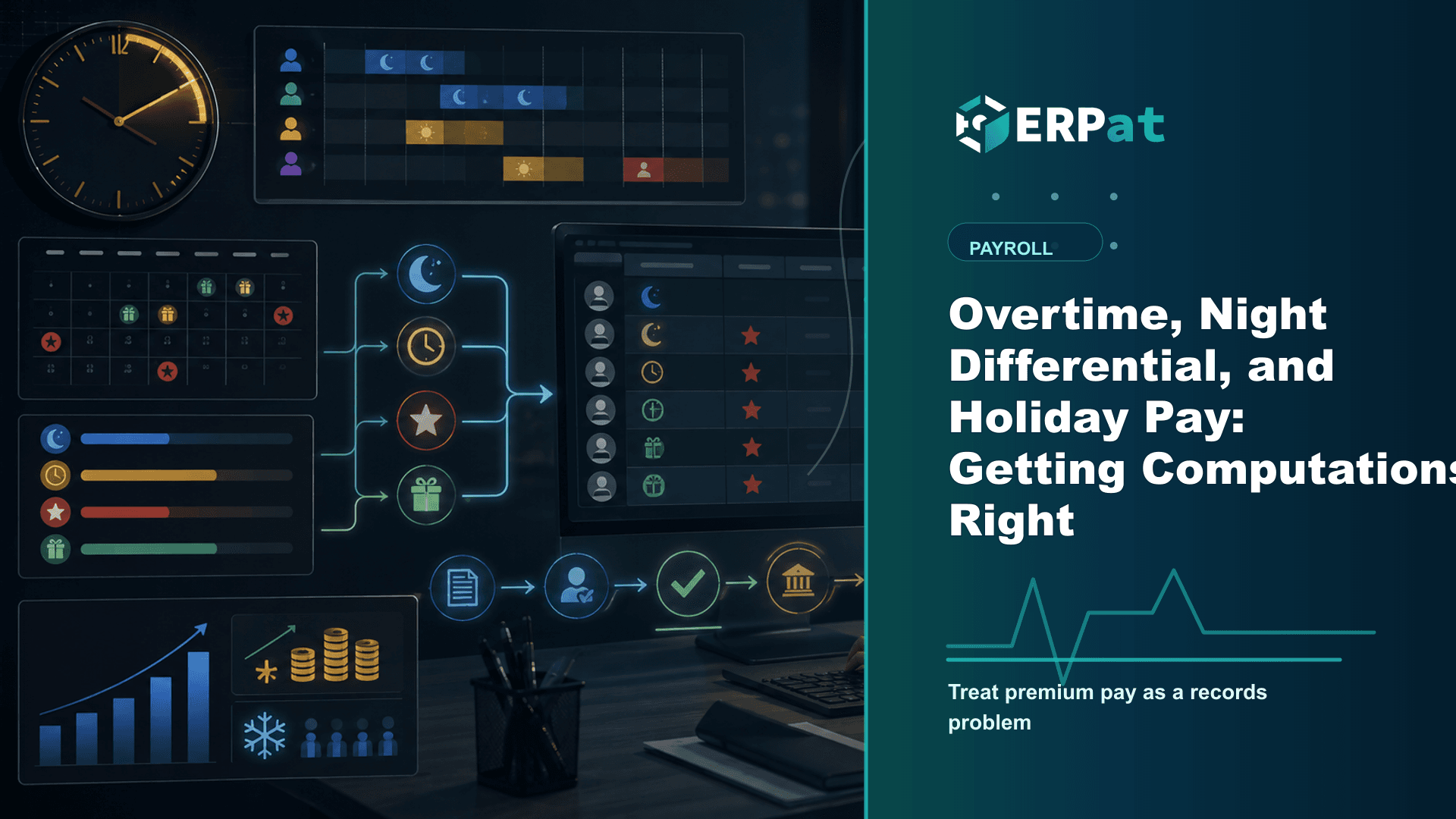
Overtime, Night Differential, and Holiday Pay: Getting Computations Right
Premium pay is where most Philippine payroll errors live. This guide walks through regular holidays versus special days, how night differential is actually counted, and why stacked premiums have to be sequenced rather than added.
In this guide
What to watch for
Use the article to spot where payroll checks can be clearer, faster and easier to audit.
In this article
- Most premium pay errors are classification errors
- Regular holidays and special days are different instruments
- Night differential is defined by the clock, not by the shift
- Premiums stack, and the order of computation matters
- The base rate decides everything downstream
- The errors surface again at year end
- Treat premium pay as a records problem
Base pay rarely causes an argument. Premium pay does, because it is the part of the payroll register that changes shape every month: a proclamation moves a holiday, someone works past midnight, a rest day gets swapped. The rules behind overtime, night differential and holiday pay are not individually difficult, but they interact, and one wrong assumption about what kind of day it was multiplies quietly across every affected employee.
Most premium pay errors are classification errors
The arithmetic is almost never the problem. A spreadsheet multiplies correctly; what it multiplies is what goes wrong. The day was tagged as a special day when the proclamation declared it a regular holiday. An employee's rest day was moved that week and nobody told payroll. A night shift was paid flat because it is "a night shift" in everyone's head and nobody counted which hours actually fell inside the statutory window.
These errors have two properties that make them expensive. They are systematic, so they repeat every cutoff until somebody notices, and they are quiet, because an underpaid premium does not look like an error on a payslip. It just looks like a smaller number. They tend to surface at the worst possible moment: during a final pay computation, in a DOLE inspection, or when two employees on the same schedule compare payslips and find they do not match.
Regular holidays and special days are different instruments
Article 94 of the Labor Code entitles every worker to his regular daily wage during regular holidays and requires compensation equivalent to twice the regular rate for work performed on a holiday. Two things follow from that. An employee who does not work on a regular holiday is still paid for the day, and an employee who does work is paid on a doubled basis rather than an ordinary one. The same article exempts retail and service establishments regularly employing fewer than ten workers, which is a genuine exemption a small shop may rely on and a growing one eventually outgrows.
Special days are a different instrument. They are not covered by Article 94, and the default is the no-work-no-pay principle unless a company policy, an employment contract or a collective bargaining agreement provides otherwise. Work performed on a special day carries a premium rather than the doubled rate. Because the mix of regular holidays and special days is set by proclamation and shifts from year to year, day types have to be read off the current proclamation rather than copied from last year's calendar.
Night differential is defined by the clock, not by the shift
Night shift differential attaches to hours worked between ten o'clock in the evening and six o'clock in the morning. The word doing the work in that sentence is hours. It is not a shift allowance, not a bonus for staff assigned to the graveyard roster, and not something that covers a whole shift because part of it happens to fall at night.
That distinction produces most night differential errors. A shift running from 6 p.m. to 3 a.m. earns the differential for only part of its hours. An employee who stays two hours past a shift ending at 9 p.m. crosses into the window for the second hour and not the first. And because the window straddles midnight, those hours belong to two calendar days, which matters a great deal when the second of them is a rest day or a holiday.
None of this can be derived from the shift schedule alone. It has to come from actual time records, hour by hour, which is why night differential is usually the first premium to break when attendance is captured on paper and summarised by hand.
Premiums stack, and the order of computation matters
Overtime, night differential and holiday pay are not three separate line items drawn from one common base. They compose. Overtime worked on a regular holiday is computed on the holiday-adjusted hourly rate, not the ordinary one, because the holiday has already changed what an hour of that employee's time is worth. Night differential on those same overtime hours builds on the rate as already adjusted.
Get the sequence wrong and the error compounds rather than cancels. The combinations that break flat spreadsheets are the ones carrying three modifiers at once: a rest day that is also a special day, worked past the eight-hour normal workday, into the night window. Each modifier is simple in isolation; together they have to be applied in order instead of summed at the end. "We just add the premiums afterwards" is a warning sign, not a simplification, because adding premiums to the ordinary rate and stacking them on an already-adjusted rate give different answers, and only one of them is correct.
A payroll system sequences premiums correctly only if the day type and the timestamps behind them are correct. A regular holiday tagged as a special day, or a shift logged from the roster instead of from actual time in and out, produces a clean, confident and wrong computation.
The base rate decides everything downstream
Every premium is a multiple of something, so that something has to be right before anything else can be. For daily-paid employees the daily rate is the starting point. For monthly-paid employees it has to be derived, and the divisor used to convert a monthly salary into a daily and then hourly rate must be consistent with the days the company actually pays. A company using one factor for leave conversion and another for overtime ends up with two different hourly rates for the same employee, and no amount of correct premium logic will reconcile them.
Wage orders reset that base on a fixed date. Wage Order No. NCR-23 raised the National Capital Region daily minimum wage by P33.00 effective 04 June 2022, bringing the non-agriculture rate to P570.00. Every overtime hour, night differential hour and holiday premium for an affected employee moves with it from that date. Applying a wage order to the base rate while leaving premium computations on the old figure is a recurring underpayment that nobody sees on the face of the payslip.
The errors surface again at year end
Misclassification does not stay inside the cutoff where it happened. Under Presidential Decree No. 851, 13th month pay is one-twelfth of basic salary within the calendar year, so what gets posted as basic pay and what gets posted as premium pay changes the December figure. An amount parked in the wrong column for eleven months is not something the last payroll run can quietly correct.
Withholding is the other place it shows. Minimum wage earners are exempt from income tax and withholding on their statutory minimum wage, and that exemption also covers their holiday pay, overtime pay, night shift differential pay and hazard pay. For employees who are not minimum wage earners, those same premiums form part of taxable compensation. Classifying a premium correctly is therefore both a labor standards question and a withholding question, and both look at the same field.
Treat premium pay as a records problem
None of these rules are hard to state. What makes them hard to comply with is that each one depends on a fact recorded somewhere else: the day type the proclamation assigned, the hours the employee actually worked, the rest day that applied that week, the wage order in force on that date. When those facts are re-keyed from one system into another, the premium computation inherits every transcription error along the way. ERPat's Compensation module works from attendance data directly, producing earnings, deductions, allowances and payslips without that re-typing step. The rules still have to be configured correctly, but at least they are being applied to real hours.
Compliance context
Turn "Overtime, Night Differential, and Holiday Pay: Getting Computations Right" into a compliance checklist
Compliance-heavy articles are most useful when they become a repeatable review habit. Treat the guidance as a way to confirm evidence, ownership and timing before reports or payroll records are submitted.
Part 1Documents and records to prepare
Before the team reviews compliance requirements, make sure the supporting records are complete and traceable.
- Employee master records, pay history, schedules, leaves and attendance logs
- Contribution, tax, deduction and adjustment summaries
- Approval records, exception notes and revision history
Part 2Common gaps to prevent
Compliance gaps often come from missing evidence rather than missing intent. The system should make proof easy to find.
- Late updates to employee status, salary rates or tax/contribution details
- Manual corrections without a reason or reviewer attached
- Reports generated from data that does not match the approved payroll run
Part 3How to make review repeatable
Create a simple rhythm: prepare records, run checks, document exceptions, approve, then lock the final version.
- Use the same checklist every cutoff or reporting period
- Assign one owner for exceptions and one owner for final approval
- Keep final reports and supporting details together for later audit review
Chelsea Cuevas
Content & Marketing Associate
Covers business growth, HR best practices, and the technology behind modern operations.