
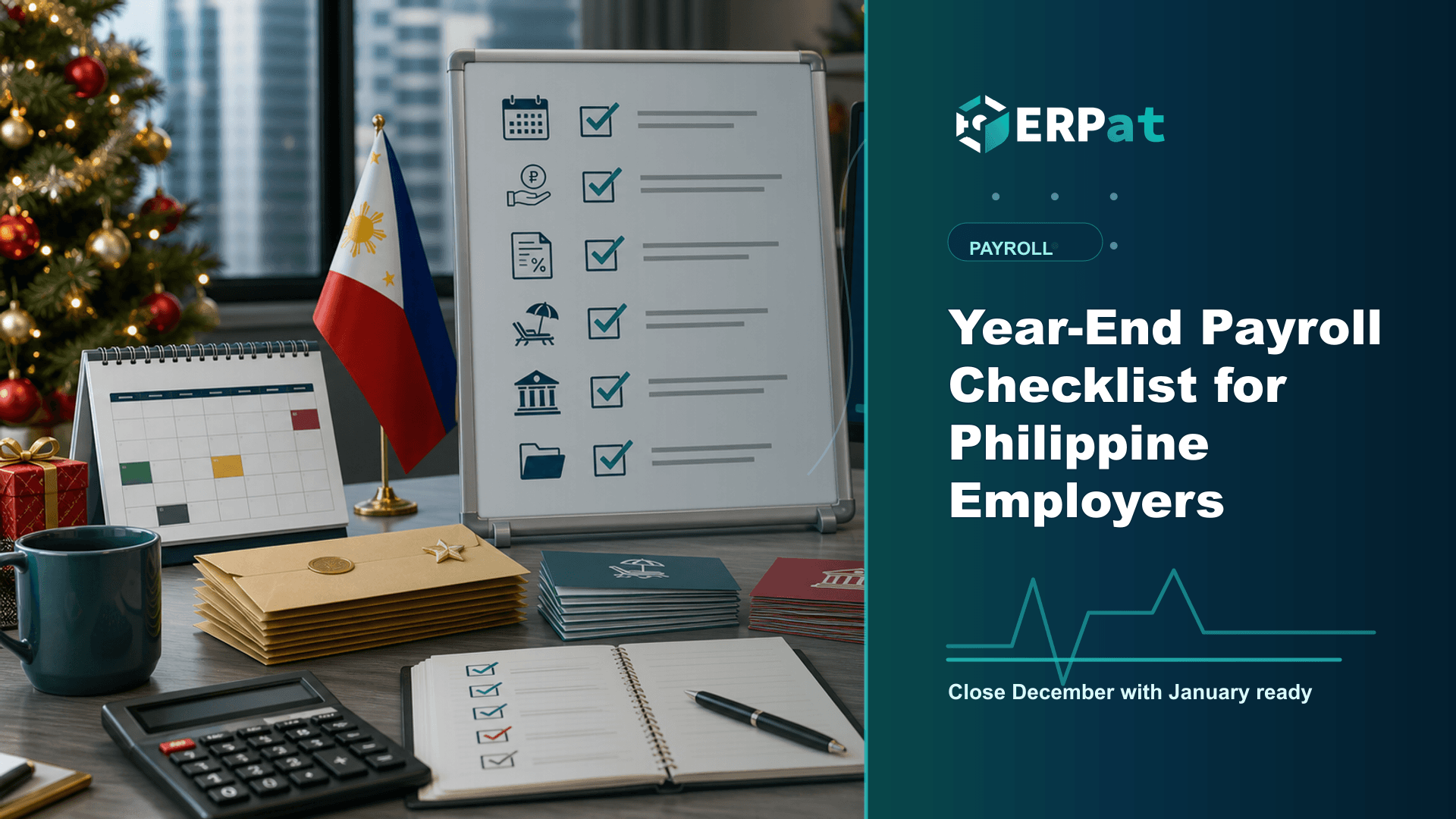
Year-End Payroll Checklist for Philippine Employers
December compresses a final cutoff, the statutory 13th month release, the last remittances of the year and tax annualization into three short weeks. This checklist walks the close in the order it actually has to happen.
In this guide
What to watch for
Use the article to spot where payroll checks can be clearer, faster and easier to audit.
In this article
- Lock the December cutoffs before anything else
- Release the 13th month pay by December 24
- Reconcile the exempt cap and annualize withholding
- Convert unused leave and settle year-end entitlements
- Clear the remittances and check what changes in January
- Build the file January will ask for
- Going into January with a clean ledger
December is the shortest working month and the heaviest payroll month. A final cutoff, a statutory 13th month release, the last government remittances of the year and the annualization of withholding tax all land inside about three weeks. None of it is difficult on its own, but the month punishes sequence errors — a figure you fix in January is one you explain twice.
Lock the December cutoffs before anything else
Fix the attendance cutoff and publish it to managers early, because every downstream number depends on it. Late timesheets, unapproved overtime and unfiled leave are the usual sources of a January correction. December also carries regular holidays, and Article 94 of the Labor Code entitles workers to their regular daily wage on a regular holiday and twice the regular rate for work performed on one, so premium computations draw more scrutiny this month.
This is where an integrated setup earns its keep. In ERPat, the Human Resource module holds profiles, schedules, attendance, leaves and holidays, and the Compensation module builds earnings, deductions and allowances straight from that attendance. Fewer manual re-keys between timekeeping and payroll means fewer corrections.
Decide now what else is in scope: retroactive adjustments, final pay for leavers, and correction runs. Anything landing after December 31 becomes a prior-year adjustment.
Release the 13th month pay by December 24
Presidential Decree No. 851 requires 13th month pay to be paid not later than December 24 of every year, and its implementing rules define the benefit as one-twelfth of the employee's basic salary within the calendar year. Memorandum Order No. 28 removed the original P1,000 monthly salary ceiling in 1986, so every rank-and-file employee is covered.
Because the base is basic salary earned within the calendar year, a mid-year hire, a mid-year separation and unpaid periods all produce a proportionate figure rather than a flat month. Before the run, confirm which of your pay elements the system actually treats as basic salary. That one configuration decision drives every employee's amount.
If you release in two tranches, December must still bring each employee to the full statutory amount by the 24th. Employees who separated during the year are entitled to a proportionate share too — check that no separation date has quietly dropped someone from the run.
Reconcile the exempt cap and annualize withholding
13th month pay and other benefits are excluded from gross income and exempt from withholding up to a total of P90,000 per year; any excess is taxable compensation subject to withholding. That reconciliation belongs in December, because the excess has to be taxed in the year it was actually received.
Annualization is the other December-only task: compare what you withheld across the year against the annual tax due on total taxable compensation, using the graduated schedule in force for taxable years 2018 to 2022, under which the first P250,000 of annual taxable income is taxed at zero. Both over-withholding and under-withholding get corrected here, which is why the last payslip of the year draws the most questions.
Minimum wage earners are exempt from income tax and withholding on their statutory minimum wage, and that exemption extends to their holiday pay, overtime pay, night shift differential and hazard pay. Confirm those classifications before you annualize, not after.
Convert unused leave and settle year-end entitlements
Article 95 gives every employee who has rendered at least one year of service five days of paid service incentive leave a year. Under the Omnibus Rules implementing the Labor Code, that leave is commutable to its money equivalent if it is not used or exhausted at the end of the year. Employees already enjoying the benefit, those with at least five days of paid vacation leave, and establishments regularly employing fewer than ten employees fall outside the requirement.
In practice, your leave ledger and your payroll have to agree before the final run. Balances sit with the employee record — the Human Resource module carries leaves and holidays alongside profiles and schedules — and the conversion is paid through Compensation as an ordinary earning, so it lands on the payslip and in the year's totals rather than as an off-system disbursement. Hotels and restaurants should review service charges in the same pass: since RA 11360 amended Article 96, collected service charges go completely and equally to covered workers except managerial employees.
Clear the remittances and check what changes in January
For 2021 the SSS contribution rate is 13% of the monthly salary credit — 8.5% employer and 4.5% employee — with the MSC floor at P3,000 and the ceiling at P25,000. Regular employers remit by the last day of the month following the applicable month, and if that date falls on a Saturday, Sunday or holiday you may pay on the next working day. Do not forget the WISP split that began with the January 2021 applicable month: the regular fund is credited only up to an MSC of P20,000, and the portion above that goes to the provident fund, so one deduction reconciles against two funds.
PhilHealth collected at 3.00% through 2021, with the income ceiling held at P60,000 after the scheduled increase was deferred under a moratorium. Pag-IBIG remains 1% for employees earning not more than P1,500 a month and 2% above that, against a 2% employer counterpart on a maximum fund salary of P5,000 — P200 a month at the cap. Remittance must go through an accredited electronic facility, and unremitted amounts carry a 3% per month penalty.
The schedule in RA 11223 sets the 2022 premium at 4.00% over a P10,000 to P80,000 range, but the 2021 step in that same schedule was suspended before it was ever collected. Wait for PhilHealth's own advisory before changing the rate in your January setup.
Build the file January will ask for
Every employer must furnish each employee from whom taxes were withheld a BIR Form 2316 on or before January 31 of the following year — or on the day the last payment of compensation is made if employment ended earlier, the part most often missed for mid-year leavers. BIR Form 1604-C and the alphalists of employees are due on that same date, and where substituted filing applies, duplicate copies of the 2316 with the certified list of qualified employees go to the BIR not later than February 28.
Those returns are only as accurate as the master data behind them: complete names, TINs, hire and separation dates, and a clean mapping of every earning and deduction for the year. Assembling that in the last week of January is how errors get in — pull it together in December while the payroll team still has the context, and keep the employee record as the single source of truth. Employees outside substituted filing file their own annual return by April 15, and the 2316 you issue is what they file it with.
Going into January with a clean ledger
December is difficult not because any single item is hard, but because four clocks — a cutoff, a statutory release date, a remittance window and a reporting cycle — run out inside the same three weeks. Work them in that order, get the employee and attendance data right once, and January becomes a reporting month instead of a correction month.
Compliance context
Turn "Year-End Payroll Checklist for Philippine Employers" into a compliance checklist
Compliance-heavy articles are most useful when they become a repeatable review habit. Treat the guidance as a way to confirm evidence, ownership and timing before reports or payroll records are submitted.
Part 1Documents and records to prepare
Before the team reviews compliance requirements, make sure the supporting records are complete and traceable.
- Employee master records, pay history, schedules, leaves and attendance logs
- Contribution, tax, deduction and adjustment summaries
- Approval records, exception notes and revision history
Part 2Common gaps to prevent
Compliance gaps often come from missing evidence rather than missing intent. The system should make proof easy to find.
- Late updates to employee status, salary rates or tax/contribution details
- Manual corrections without a reason or reviewer attached
- Reports generated from data that does not match the approved payroll run
Part 3How to make review repeatable
Create a simple rhythm: prepare records, run checks, document exceptions, approve, then lock the final version.
- Use the same checklist every cutoff or reporting period
- Assign one owner for exceptions and one owner for final approval
- Keep final reports and supporting details together for later audit review
Jerome Evangelista
Content & Solutions Writer
Writes about payroll automation, HRIS, and how Philippine businesses run leaner with ERPat.