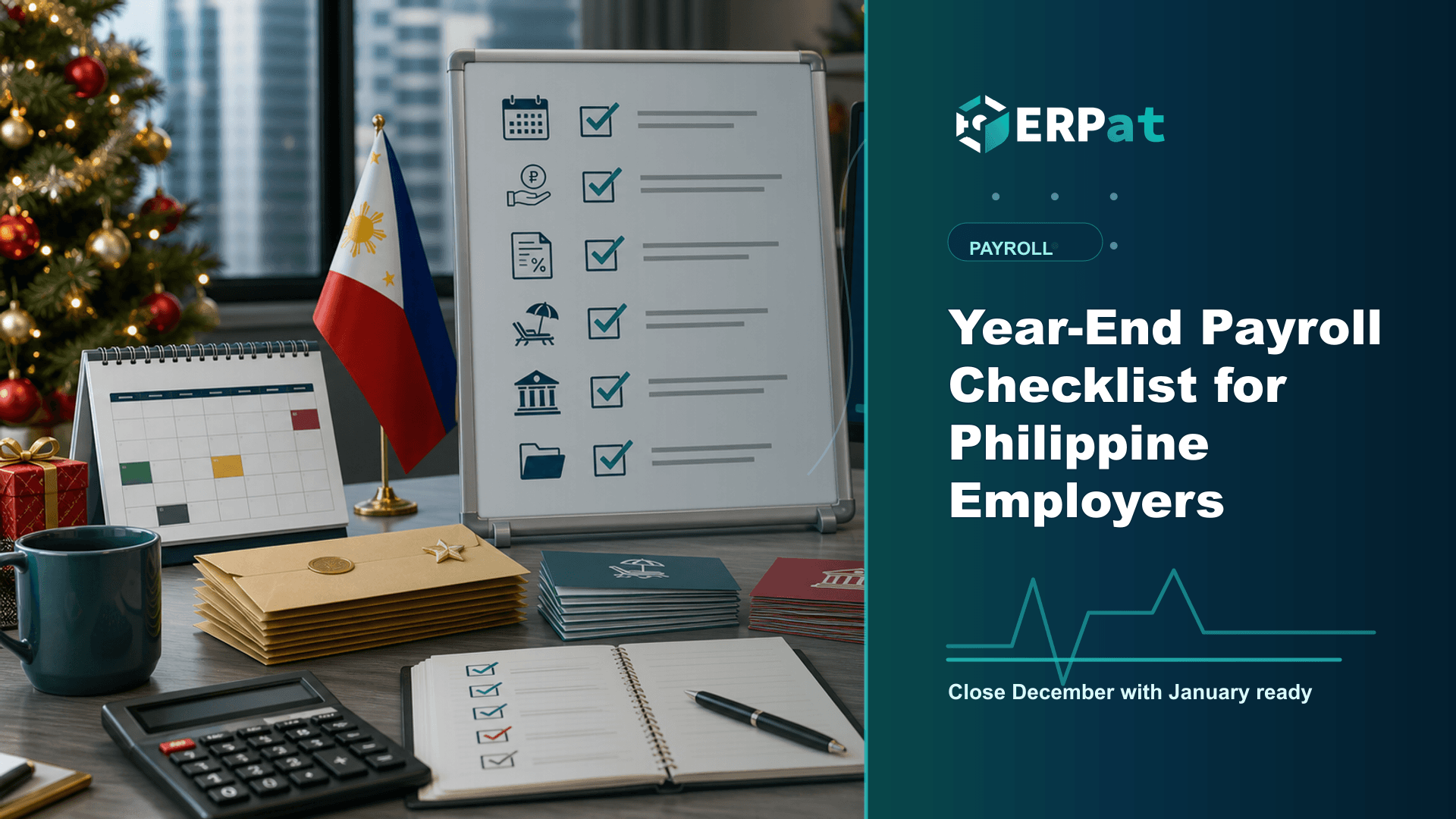

Year-End Payroll Reconciliation Before December 24
December 24 is a statutory deadline, not a target date. A practical walkthrough of reconciling attendance, the payroll register and the general ledger so year-end variances surface while there is still time to correct them.
In this guide
What to watch for
Use the article to spot where payroll checks can be clearer, faster and easier to audit.
In this article
- Why the deadline is December 24, not year-end
- Start where the numbers start: attendance
- Rebuild the 13th month base from actual basic pay
- Watch the ninety-thousand-peso line and the withholding it moves
- Reconcile payroll against the ledger, not against itself
- Close out contributions and leave before January
- Work the list backwards from December 24
December 24 is not a target date in Philippine payroll. It is a statutory deadline, and it tends to arrive while finance is still chasing December timesheets, unposted adjustments and a ledger that has not been touched since the November close. The gap between what attendance recorded, what payroll paid and what the books show is usually widest in the last three weeks of the year — which is exactly when you have the least time to close it. The work below is about surfacing those variances now, while a correction is still a correction and not a January restatement.
Why the deadline is December 24, not year-end
Presidential Decree No. 851 requires employers to pay 13th month pay "not later than December 24 of every year," and its implementing rules define the benefit as one-twelfth of the employee's basic salary within a calendar year. Memorandum Order No. 28, signed in 1986, removed the original monthly salary ceiling, so every rank-and-file employee is covered regardless of pay level.
The practical consequence is a scheduling problem that catches teams every December. Payroll's year effectively closes about a week before the accounting year does, which means you are reconciling against a calendar year that has not finished elapsing. Most teams handle this by computing the benefit on basic salary earned from January through the last completed payroll period, then truing it up in the final cut-off. That is defensible — but it only works if the earlier months are already clean. A variance you discover on December 26 is still payable; it is simply payable late, and it lands on top of the January reporting cycle instead of ahead of it.
Start where the numbers start: attendance
Every peso in the payroll register begins as a timekeeping record, so that is where reconciliation has to begin too. The Labor Code premiums are the usual hiding places: overtime at the regular wage plus at least twenty-five percent, night shift differential of at least ten percent for hours worked between ten in the evening and six in the morning, at least thirty percent additional pay for work on a scheduled rest day, and holiday pay at twice the regular rate for work performed on a regular holiday. Each of those is a multiplier applied to a count of hours, and each is only as accurate as the hours behind it.
Run two population checks before anything else: employees who appear in the payroll register but have no attendance record for the period, and employees with attendance who were not paid. Then look at everything entered outside timekeeping — manual adjustments, retroactive pay, off-cycle corrections — because those are the items no automated feed can vouch for. In ERPat, the Compensation module is fed straight from attendance, so earnings, deductions and allowances derive from the same underlying records; that narrows the variance you have to explain to the manual layer sitting on top.
A payroll system computes correctly from whatever attendance data it is given, including data that is still incomplete. Lock the December cut-off and settle pending corrections before you treat any register as final.
Rebuild the 13th month base from actual basic pay
The benefit is one-twelfth of basic salary earned within the calendar year, and almost every dispute about the amount is really a dispute about what "basic" means. Overtime pay, night shift differential, holiday premiums and allowances are not part of basic salary, so a computation run off gross pay will overstate the benefit. Rebuild the base from the basic component of each period's register, month by month, rather than from a single annualised figure.
Then handle the cases that break the twelve-month assumption. Unpaid absences reduce basic salary actually earned, and therefore reduce the benefit. Employees hired mid-year or separated during the year are entitled to a proportionate amount based on the months they actually rendered service. Employees who moved between salary rates need the base split at the effectivity date rather than computed at the current rate. None of this is difficult arithmetic; it is simply arithmetic that has to be done against real period data, which is why the reconciliation between the payroll register and the 13th month computation should be a line-by-line comparison, not a spot check on a few names.
Watch the ninety-thousand-peso line and the withholding it moves
Thirteenth month pay and other benefits are excluded from gross income and exempt from withholding tax up to a total of ₱90,000 per year; any excess over that amount is taxable compensation subject to withholding. For most rank-and-file employees this never becomes an issue, but for anyone receiving a sizeable 13th month plus other benefits, the December payroll is where the excess becomes taxable and the year-end adjustment has to absorb it.
That makes the last run of the year the wrong place to discover an error in earlier months. Minimum wage earners are exempt from income tax and withholding on their statutory minimum wage as fixed by the regional board, and that exemption also covers their holiday pay, overtime pay, night shift differential and hazard pay — so a misclassified employee distorts the annualisation in both directions. Everything computed here flows into the January filings: BIR Form 2316 must be furnished to each employee on or before January 31 of the following year, and Form 1604-C with the alphalists of employees is due on the same date. An unreconciled December register becomes an incorrect alphalist about five weeks later.
Reconcile payroll against the ledger, not against itself
A payroll register that foots to itself proves very little. The comparison that matters is against what actually posted to the books: salaries and wages expense, the accrual for 13th month pay, statutory payables for the employee shares withheld and the employer shares accrued, withholding tax payable, and loan repayments deducted from pay.
Employee loan deductions deserve particular attention because they are the quietest failure. Money withheld from an employee but not yet remitted to the lender sits as a liability, and if the payroll side and the ledger side were maintained separately during the year, the two balances drift without anyone noticing until someone asks why an employee's outstanding balance does not match their deduction history. ERPat's Finance module covers accounts, expenses, payments, loans and reconciliation with automated tax calculations and dynamic reports, which lets the payroll output and the corresponding ledger balances be compared in one place rather than through exported spreadsheets. The check you are aiming for is a three-way tie: attendance to payroll register, payroll register to ledger, and ledger to what you will actually remit.
Close out contributions and leave before January
Statutory contributions for the year should be settled on the year's own schedule rather than carried into the new one. For 2023, SSS contributions are computed at fourteen percent of the monthly salary credit — nine and a half percent employer, four and a half percent employee — with a minimum monthly salary credit of ₱4,000 and a maximum of ₱30,000, and business employers remit by the last day of the month following the applicable month. PhilHealth stayed at four percent with an ₱80,000 income ceiling for the whole of calendar year 2023, shared equally between employer and employee, and no retroactive differential was collected for the year. Pag-IBIG contributions remain one percent for employees earning not more than ₱1,500 a month and two percent above that, with a two percent employer counterpart, computed on a maximum fund salary of ₱5,000.
Leave balances belong in the same sweep. Service incentive leave — five days a year for employees with at least one year of service — is commutable to its money equivalent if it is not used or exhausted at the end of the year. That commutation is a real payable, so it either appears in a December payroll run or it sits as an accrual in the December books. It should not be discovered in February.
Work the list backwards from December 24
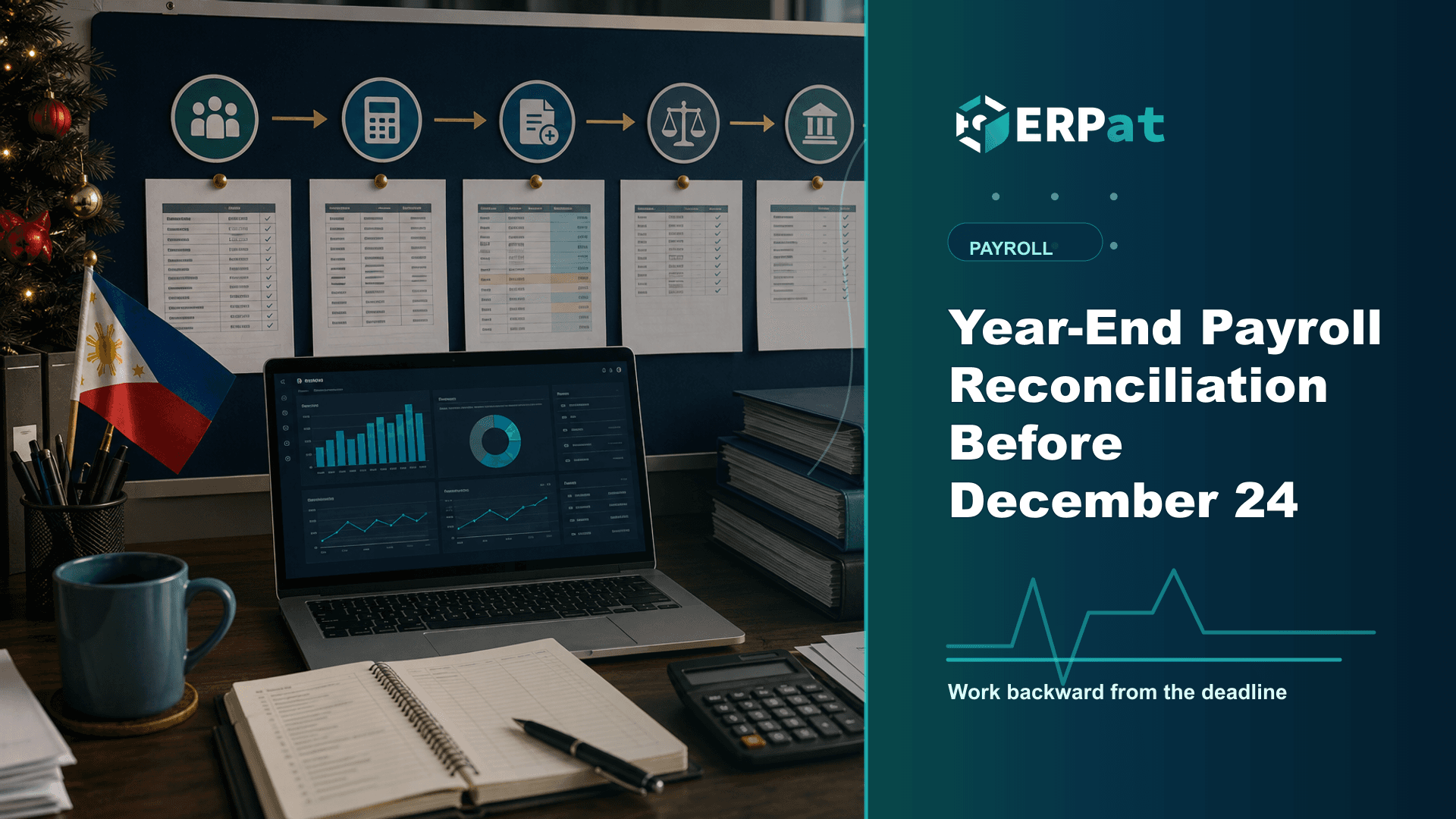
Set the date you must pay by, then count backwards: the final attendance cut-off, the review of manual adjustments, the 13th month recomputation, the ledger tie-out, and the approval window your own organisation actually needs. Most year-end payroll problems are not computation errors — they are sequencing errors, where a correction arrived after the run it should have been in. Fixing the sequence once gives you a repeatable close, and next December starts from a set of books you already trust.
Compliance context
Turn "Year-End Payroll Reconciliation Before December 24" into a compliance checklist
Compliance-heavy articles are most useful when they become a repeatable review habit. Treat the guidance as a way to confirm evidence, ownership and timing before reports or payroll records are submitted.
Part 1Documents and records to prepare
Before the team reviews compliance requirements, make sure the supporting records are complete and traceable.
- Employee master records, pay history, schedules, leaves and attendance logs
- Contribution, tax, deduction and adjustment summaries
- Approval records, exception notes and revision history
Part 2Common gaps to prevent
Compliance gaps often come from missing evidence rather than missing intent. The system should make proof easy to find.
- Late updates to employee status, salary rates or tax/contribution details
- Manual corrections without a reason or reviewer attached
- Reports generated from data that does not match the approved payroll run
Part 3How to make review repeatable
Create a simple rhythm: prepare records, run checks, document exceptions, approve, then lock the final version.
- Use the same checklist every cutoff or reporting period
- Assign one owner for exceptions and one owner for final approval
- Keep final reports and supporting details together for later audit review
Chelsea Cuevas
Content & Marketing Associate
Covers business growth, HR best practices, and the technology behind modern operations.