

Homeowners Associations and Village Management
Homeowners associations run on records that go stale quickly — who owns which lot, who lives there now, and which vehicle stickers are still valid. Here is how a village information system keeps those three answers in one place.
In this guide
What to watch for
Use the article to identify repeat work, handoff gaps and places where one source of truth would help.
In this article
A homeowners association is, in administrative terms, a small records office, a small billing department and a small security operation running at the same time. Officers change every year or two, the treasurer keeps one set of files, the guardhouse keeps another, and the only complete picture of who lives where sits in the memory of whoever has been around the longest. That holds up until it doesn't — usually at the gate, late at night, when a guard has to decide whether the person in front of him belongs inside.
Start with the property, not the person
The most common mistake in village records is organising everything around homeowners. People are the volatile part. Lots are not. A property — block and lot, phase, street address, area, whether it is built on or still vacant — stays fixed for decades, which makes it the natural spine for everything else the association tracks.
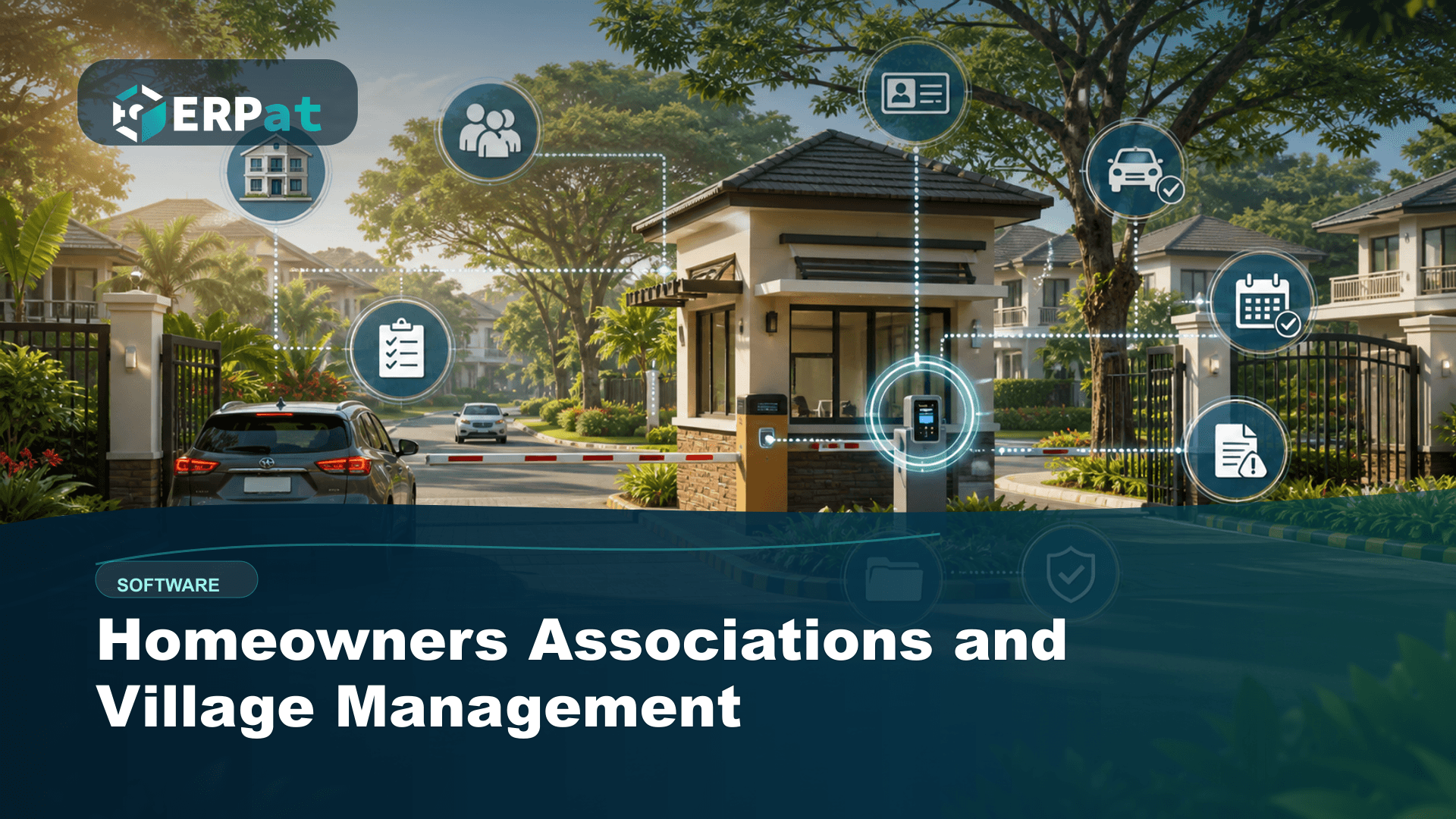
The Village module is built on that idea: it is a homeowners association information system for villages, subdivisions and gated communities, covering properties, households, access credentials and security. Register the properties first and you get a complete denominator. You know how many lots exist, how many are occupied, how many are vacant, and which ones nobody has heard from in two years.
Once the property list is real, every other question becomes answerable by attachment rather than by recall. Who owns this lot. Who lives in it now. What credentials have been issued against it. Which incidents have been logged near it. None of that requires a new system — it requires one record that the others hang from.
Households turn over faster than titles
The registered owner and the occupying household are frequently not the same people, and treating them as one field is where most association records start to drift. An owner may live abroad and rent the house out. A parent may hold the title while an adult child lives there. A household will include family members, a live-in helper, a driver, sometimes a long-term guest.
That distinction has practical consequences. Dues, notices and voting rights follow the owner. Access, deliveries and community rules follow the occupants. A guard checking a name at three in the afternoon needs the second list, not the first, and if the system only stores homeowners he will improvise — which is exactly the discretion that later becomes a complaint at the general assembly.
Recording households against properties, and keeping the current occupants separate from the titleholder, gives both sides of the association what they need from the same file. The treasurer still bills the owner. The gate still verifies the resident.
Access credentials only work if the list behind them does
Most villages already issue some combination of vehicle stickers, resident identification and gate passes for helpers, drivers and contractors. The physical credential is rarely the weak point. The weak point is the register — who was issued what, against which property, and whether that relationship still exists.
Credentials outlive people. A tenant moves out in March and the vehicle sticker on the windshield still opens the same gate in November, because nothing in the process connected the end of the lease to the cancellation of the pass. Multiply that by a few years of turnover and the association no longer knows how many valid credentials are circulating.
Tracking credentials inside the same system that holds the properties and households closes that loop. When an occupancy ends, the credentials issued under it are visible in one place instead of being remembered by one officer. It is an unglamorous piece of housekeeping, and it is the difference between a controlled perimeter and a decorative one.
What the guardhouse actually needs
Security personnel are usually the association's most consistent data source and its least supported one. They are present twenty-four hours a day, they see everything, and they are typically given a logbook and a ballpen. The Patrol module is a digital security-operations suite intended for that gap.
The value is cumulative rather than dramatic. One logged visitor entry is trivia; a year of them is a pattern the board can act on when deciding gate hours, staffing or where to put a light.
Documents that outlive the board
Associations are governed by paper: by-laws, board resolutions, assembly minutes, service contracts, insurance policies, approved building plans. That paper has to survive officers who serve for a term and then hand over a box, a flash drive, or nothing at all.
The Documents module provides centralised storage with role-based access controls and version tracking. Role-based access matters because not every record belongs to everybody — a contractor agreement is board business, while the by-laws should be readable by any member. Version tracking matters because associations amend things, and an amended house rule that still circulates in three older forms is unenforceable in practice.
The immediate benefit is mundane and real: the incoming board inherits a repository instead of a rumour about where the files went. The longer-term benefit is that disputes get settled by reference to a document with a known history, rather than by whoever remembers the meeting best.
What a system will not do for you
Software gives an association a shared record. It does not give it a functioning board, an enforced set of house rules, or members who pay on time. If nobody updates a household when a tenant moves out, the register drifts exactly as a spreadsheet would, and the guard is back to improvising.
There is also a quiet obligation attached to all of this. A village database holds names, addresses, household composition, vehicle details and visitor histories — genuinely sensitive information about private residents. Deciding who inside the association may see which parts of it is a governance decision that access controls enforce but cannot make for you.
Where to begin
Start with the property register, because it is finite, verifiable and already half-written in whatever files the association keeps. Attach households to it, then credentials, and only then worry about the guardhouse workflow. Communities that try to launch everything at once usually stall on data entry; the ones that get somewhere fix the spine first and let the rest accumulate.
Technology decision context
Use "Homeowners Associations and Village Management" to make a better systems decision
Technology articles are most useful when they help the team decide what to change next. Focus on the process problem first, then choose the tool or integration that removes the most repeated work.
Part 1Start from the workflow, not the tool
A system change should solve a visible operational problem. Map who creates data, who reviews it and who depends on the result.
- Identify repeated encoding, manual exports and duplicate records
- Find handoffs that rely on reminders instead of system status
- Separate must-have controls from nice-to-have interface features
Part 2Integration details to check
A useful system should reduce context switching and make data easier to trust across teams.
- Which records need one source of truth?
- Which reports depend on data from more than one department?
- What permissions, audit logs and backups are required?
Part 3How to judge success
A better technology setup should improve speed, reliability and confidence in decisions.
- Fewer manual workarounds after rollout
- Shorter time from request to approval or report
- Clear ownership when something is missing or incorrect
Chelsea Cuevas
Content & Marketing Associate
Covers business growth, HR best practices, and the technology behind modern operations.