

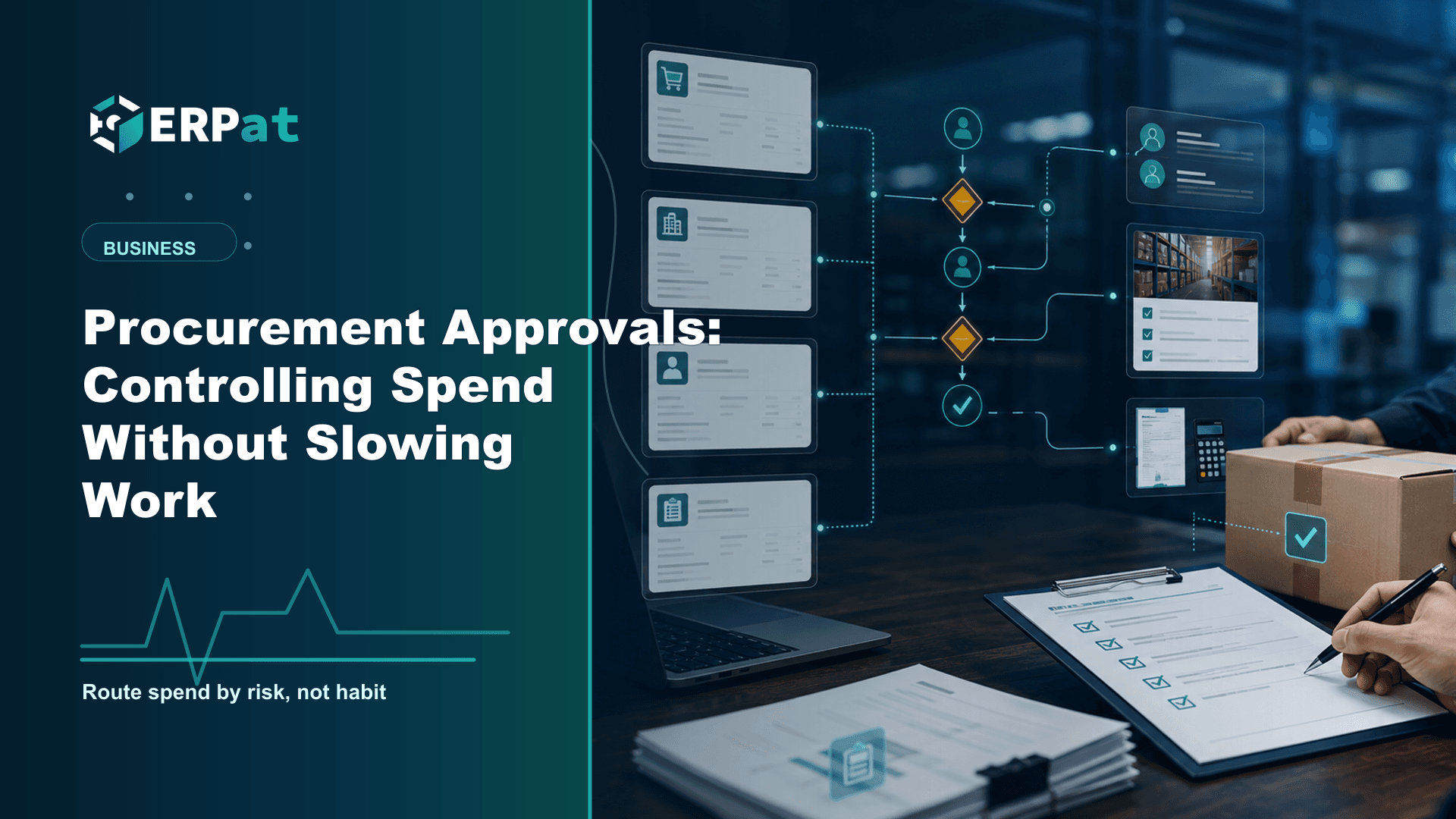
Procurement Approvals: Controlling Spend Without Slowing Work
Purchase requests, vendor records, layered approvals and receiving are the four points where spend control either works or leaks. Here is how to structure each one without turning buying into a bottleneck.
In this guide
What to watch for
Use the article to identify repeat work, handoff gaps and places where one source of truth would help.
In this article
Most companies do not lose money on the purchases someone argued about. They lose it on the ones nobody saw until the invoice arrived — the rush order placed by phone, the annual service that renewed at a new rate, the supplier a departed staff member introduced and nobody else knows how to contact. Spend control is less about saying no and more about seeing a commitment before it becomes an obligation.
Where the leaks actually start
In a small company, purchasing begins informally and often stays that way for years. Someone needs something, mentions it to a manager, gets a nod in a chat thread, and orders it. That works when there are ten people and one office. It stops working the moment there are several sites, several people with buying authority, and a finance officer trying to reconcile invoices against commitments nobody wrote down.
The failure is rarely fraud. It is far more often ambiguity: two departments ordering the same item from different suppliers, a service renewing because nobody owned the decision to stop it, a delivery accepted at the gate with no record of what was ordered in the first place. By the time these surface, the money is spent and the conversation becomes an audit rather than a decision.
What fixes this is not a stricter policy document. It is moving the decision earlier, to the point where approving or declining is still cheap.
The purchase request is the control point
A purchase order is a commitment to a supplier. A purchase request is a question to your own organisation, and that is a very different thing. It asks what is needed, why, roughly what it will cost, and when. Answering those four questions takes a requester a few minutes and gives an approver almost everything needed to decide without calling a meeting.
ERPat's Procurement module is built around that sequence: requests are raised first, reviewed, and only then carried forward. The practical benefit is that every commitment has an origin you can trace back to a named person and a stated reason. When finance later asks why a line exists, the answer sits in the record rather than in someone's memory.
It also changes behaviour. When a requester has to write down a justification, marginal purchases quietly stop being raised at all. That is spend control that costs nothing to enforce.
Approvals should follow the risk, not the org chart
Multi-step approval is often implemented as a chain of seniority — supervisor, then manager, then owner — regardless of what is being bought. That is the fastest way to make an approval process resented. A box of bond paper does not need three signatures, and a two-year service contract deserves more scrutiny than one.
Structure the steps around risk instead. Value is the obvious dimension: small routine items cleared by the immediate supervisor, larger amounts escalating further. Category matters too. Anything that creates a recurring obligation, commits the company to a new supplier, or touches a regulated area warrants a step that an office consumable does not. The Procurement module supports multi-step approvals precisely so the route can differ by situation instead of forcing everything through one queue.
Every step needs a named alternate for leave, sick days and field work, or the process stalls the first week someone is out. Decide who covers whom before you switch the routing on, not after the first urgent request is already stuck.
Vendor records that outlive the people who chose them
Supplier knowledge in most small and mid-sized companies lives in individual heads and personal phone contacts. The person who negotiated the terms remembers them; when that person resigns, the company keeps the supplier but loses the relationship — the agreed payment terms, the contact who actually answers, the history of late deliveries that justified switching in the first place.
Vendor management inside the Procurement module exists to make that knowledge institutional. A vendor record holds contact details, terms and the history of what was bought, so the next buyer starts informed rather than starting over. It also makes consolidation visible: when three departments have each been buying the same category from three suppliers, that only becomes obvious once the records sit in one place.
There is a compliance angle as well. Keeping supplier documentation and transaction history organised makes BIR-facing work considerably less painful, because the records are assembled continuously instead of reconstructed under deadline pressure.
Receiving is where the record meets reality
An approval process that ends at the purchase order controls intent, not outcome. What arrives is frequently not what was ordered: partial deliveries, substituted items, quantities short by a carton. If receiving amounts to a signature on the delivery receipt at the gate, that difference stays invisible until an invoice is queried weeks later, if ever.
Recording receipt against the original request closes the loop. The Procurement module carries the process through to receiving, so one document trail shows what was asked for, what was approved, and what physically arrived. Discrepancies surface while the delivery is still a recent memory and the supplier can still be held to it.
This is also what makes payables defensible. Finance pays against evidence that goods were received rather than against a supplier's invoice alone, which is how companies end up paying twice for one delivery, or paying in full for one that never fully arrived.
Speed is a control, not a trade-off
Every procurement process competes with the informal one it replaced. If routing a request takes three days and calling the supplier directly takes an hour, people will call the supplier and apologise afterwards. A control that is routinely bypassed is not a control; it is documentation of a rule nobody follows.
So design for the common case. Most requests in a typical month are small, routine and low-risk, and they should clear in a single step. Reserve the longer routes for the minority of purchases where the amount or the commitment justifies the delay. Keep the pending queue visible, so approvers are not the bottleneck by accident and requesters can see where a request is sitting instead of chasing it by message.
The test is simple. Ask the people who actually buy things whether the process is faster than working around it. If the honest answer is no, tighten the route rather than the policy.
Start with the spend you already regret
You do not need to formalise every category at once. Pick the one that has already caused a problem — the recurring services nobody owns, or the site that keeps ordering outside agreed terms — and put just that category through requests, approvals and receiving for a quarter. The record you build will tell you more about your own spending patterns than another policy discussion will.
Procurement discipline compounds quietly. Nothing dramatic happens in the first month. By the fourth you have a vendor list you trust, an approval route people use without complaining, and receiving records that turn the invoice queue into a formality instead of an investigation.
Technology decision context
Use "Procurement Approvals: Controlling Spend Without Slowing Work" to make a better systems decision
Technology articles are most useful when they help the team decide what to change next. Focus on the process problem first, then choose the tool or integration that removes the most repeated work.
Part 1Start from the workflow, not the tool
A system change should solve a visible operational problem. Map who creates data, who reviews it and who depends on the result.
- Identify repeated encoding, manual exports and duplicate records
- Find handoffs that rely on reminders instead of system status
- Separate must-have controls from nice-to-have interface features
Part 2Integration details to check
A useful system should reduce context switching and make data easier to trust across teams.
- Which records need one source of truth?
- Which reports depend on data from more than one department?
- What permissions, audit logs and backups are required?
Part 3How to judge success
A better technology setup should improve speed, reliability and confidence in decisions.
- Fewer manual workarounds after rollout
- Shorter time from request to approval or report
- Clear ownership when something is missing or incorrect
Chelsea Cuevas
Content & Marketing Associate
Covers business growth, HR best practices, and the technology behind modern operations.