

Q4 Planning: Budget, Headcount, and Targets
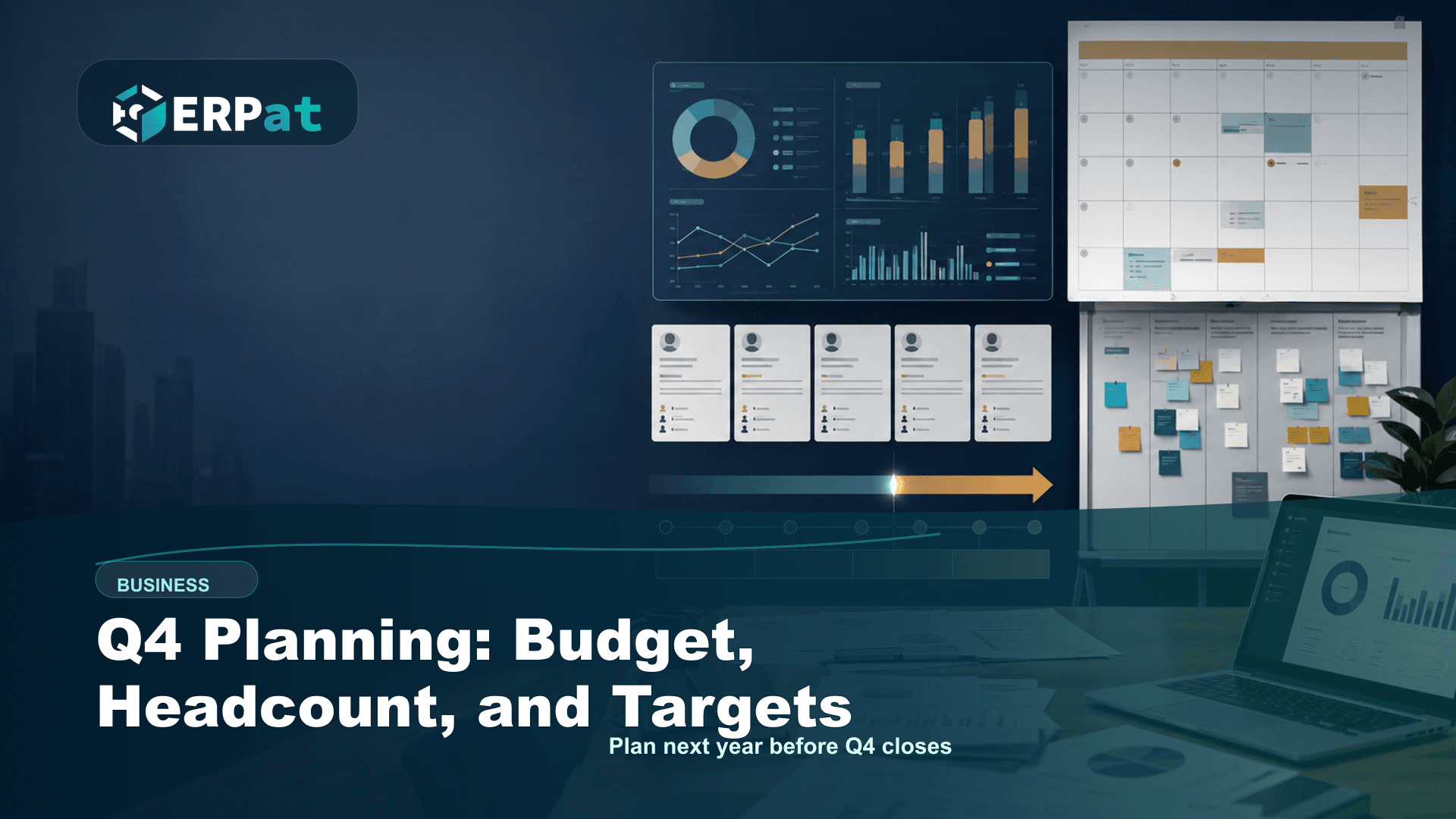
The fourth quarter is the last window to set next year's budget, headcount and targets while the current year is still closing. Here is how to run both calendars as a single planning exercise.
In this guide
What to watch for
Use the article to identify repeat work, handoff gaps and places where one source of truth would help.
In this article
By the second week of October, most Philippine SMEs are quietly running two calendars at once. One ends on December 24 and is full of obligations that cannot be moved; the other starts in January and is still a blank page. The temptation is to finish the first before touching the second, which is exactly why so many companies enter the new year with a budget approved in February and targets communicated in March. Q4 planning works better when it is treated as the handoff between the two.
The quarter already has obligations of its own
Before anything about next year, the fourth quarter carries commitments fixed by law. Presidential Decree No. 851 requires 13th month pay to be paid not later than December 24 of every year, and its implementing rules define the benefit as one-twelfth of the employee's basic salary earned within the calendar year. Memorandum Order No. 28 removed the old salary ceiling, so every rank-and-file employee is covered regardless of pay level. That is a real cash outflow with a hard date attached, competing with every other December disbursement.
Unused leave lands in the same weeks. Under Rule V, Section 5, Book III of the Omnibus Rules Implementing the Labor Code, service incentive leave that is not used or exhausted at the end of the year is commutable to its money equivalent — a payable, not a footnote.
The practical move is to know both figures in October rather than in the middle of December. Where employee records, schedules, attendance and leave balances sit in one system — as they do in ERPat's Human Resource module — the year-end liability is a query against live data instead of a reconstruction from a folder of spreadsheets.
Build the budget on the cost you actually carry
A headcount plan built on offered salaries understates what the company pays. For 2025 the SSS contribution rate is 15% of the Monthly Salary Credit, split 10% employer and 5% employee, with the MSC running from ₱5,000 to ₱35,000, plus the Employees' Compensation premium that the employer shoulders alone. PhilHealth premiums are at 5.0% of monthly basic salary with a ₱10,000 floor and a ₱100,000 ceiling, shared equally between employer and employee. The Pag-IBIG employer counterpart is 2% of the fund salary, capped since February 2024 by a ₱10,000 maximum fund salary, and the employer is legally barred from deducting that counterpart from the employee.
Those percentages are the floor under every hiring decision, and they are the part of a budget most often estimated rather than computed. Pulling last year's actuals — accounts, expenses, payments and reconciled balances — out of the Finance module gives you a cost per head that came from the ledger rather than from memory, which is a far better base for next year's assumptions than a rounded-up guess.
The January 2025 SSS increase is the final tranche of the ladder written into RA 11199, and the PhilHealth premium schedule in RA 11223 runs only through 2025. Regional wage orders are issued by the wage boards on their own timing. Carry a contingency line for statutory movement instead of writing in a figure that has not been issued.
Headcount planning starts with next year's calendar
Headcount is usually debated as a number when it is really a question of timing. A role filled in February and the same role filled in July cost very different amounts in the same fiscal year, and each start date changes the pro-rated 13th month pay that hits the following December, since the benefit accrues on basic salary actually earned within the calendar year.
The 2026 working calendar is already known. Proclamation No. 1006, signed on 03 September 2025, declares ten regular holidays for 2026, eight special non-working days, and one special working day. That is enough to see where the long weekends fall, which months are short, and which teams will need coverage or premium pay. Loading those dates into the Human Resource module's holiday and scheduling setup now means the shift plans, leave approvals and attendance records built in January are already aligned to the real calendar.
Do the same for the roles themselves. Agreeing in Q4 which positions are approved, when they open, and which manager owns each one turns hiring from a quarterly argument into a schedule finance can actually forecast against.
Set targets before the year they measure
Targets communicated in March are targets that only cover three quarters. The fourth quarter is the right time to agree not just the numbers but how performance will be measured, because the measurement design is what people argue about later. A sales figure means one thing to an account manager and another to a support lead; a scorecard that weights metrics by role makes that difference explicit instead of leaving it to interpretation.
The KPI Matrix module is built around that idea: metrics are weighted by role, individual scores roll up into a team matrix, and the resulting scores feed salary recommendations. The mechanism matters more than the tool. If the weights are set and shown to people in December, the review in the following year is a reading of an agreed scorecard. If the weights are decided afterwards, the same review becomes a negotiation, and the salary conversation that follows inherits all of it.
Keep the set small. A matrix with four or five weighted measures per role is one a manager can explain in a one-on-one; one with fifteen becomes a reporting exercise nobody trusts.
Leave room for January and February
Year-end planning that stops at December underestimates the first two months of the new year. Every employer must furnish each employee a BIR Form 2316 on or before January 31 of the succeeding year, and file BIR Form 1604-C with the alphalists of employees by the same date. For employees covered by substituted filing, the duplicate copies of Form 2316 go to the BIR, with the certified list, not later than February 28.
One December decision affects those filings directly: 13th month pay and other benefits are excluded from gross income and exempt from withholding only up to a total of ₱90,000 per year, with any excess treated as taxable compensation. Deciding the shape of year-end bonuses before the December run, rather than after, keeps the withholding correct the first time and keeps January from turning into a correction exercise while the same team is meant to be executing the new plan.
Make the handoff explicit
Q4 planning is less about producing a thicker document than about finishing three decisions while there is still time to act on them: what next year costs at current statutory rates, who is being hired and when, and how performance will be measured. Settle those in October and November, and December is only an execution month — payroll, the close, and the filings that follow. Leave them open, and the new year starts with the previous one still unfinished.
Technology decision context
Use "Q4 Planning: Budget, Headcount, and Targets" to make a better systems decision
Technology articles are most useful when they help the team decide what to change next. Focus on the process problem first, then choose the tool or integration that removes the most repeated work.
Part 1Start from the workflow, not the tool
A system change should solve a visible operational problem. Map who creates data, who reviews it and who depends on the result.
- Identify repeated encoding, manual exports and duplicate records
- Find handoffs that rely on reminders instead of system status
- Separate must-have controls from nice-to-have interface features
Part 2Integration details to check
A useful system should reduce context switching and make data easier to trust across teams.
- Which records need one source of truth?
- Which reports depend on data from more than one department?
- What permissions, audit logs and backups are required?
Part 3How to judge success
A better technology setup should improve speed, reliability and confidence in decisions.
- Fewer manual workarounds after rollout
- Shorter time from request to approval or report
- Clear ownership when something is missing or incorrect
Chelsea Cuevas
Content & Marketing Associate
Covers business growth, HR best practices, and the technology behind modern operations.