
Sales Pipelines That Connect to Invoicing
A sales pipeline that ends at the invoice removes the retyping between the deal and the ledger. Here is how leads, quotations and orders can carry the same numbers all the way through to billing.
In this guide
What to watch for
Use the article to identify repeat work, handoff gaps and places where one source of truth would help.
In this article
Ask a sales manager what a deal is worth and they will read from one file. Ask the bookkeeper what was actually billed and they will read from another. The two rarely agree on the first pass, and the cause is almost never carelessness — it is that the same figures were typed out three or four times, by different people, on different days. A pipeline that runs through to the invoice removes most of those keystrokes, and most of the discrepancy goes with them.
Where the re-keying actually happens
Trace one closed deal backwards and the duplication is easy to see. A salesperson builds a quotation in a word processor or a spreadsheet, working from a price list that lives somewhere else. The client asks for a change, so a second version is sent, usually by email. The client agrees, and someone writes up a purchase confirmation or an order form. Weeks later, finance opens the email thread, finds what they believe is the final version, and types the line items into the billing document.
Every one of those transfers is a place where a line can be dropped, a superseded price can be carried forward, or an agreed discount can quietly disappear. The failure is rarely dramatic. It is one item billed at list price when the client was promised a bundle rate, discovered only when the client refuses to pay the difference.
The second cost is time. The gap between "client said yes" and "invoice issued" is often measured in days that have nothing to do with the client and everything to do with waiting for the right person to be free to retype something.
One record that changes state, not four documents
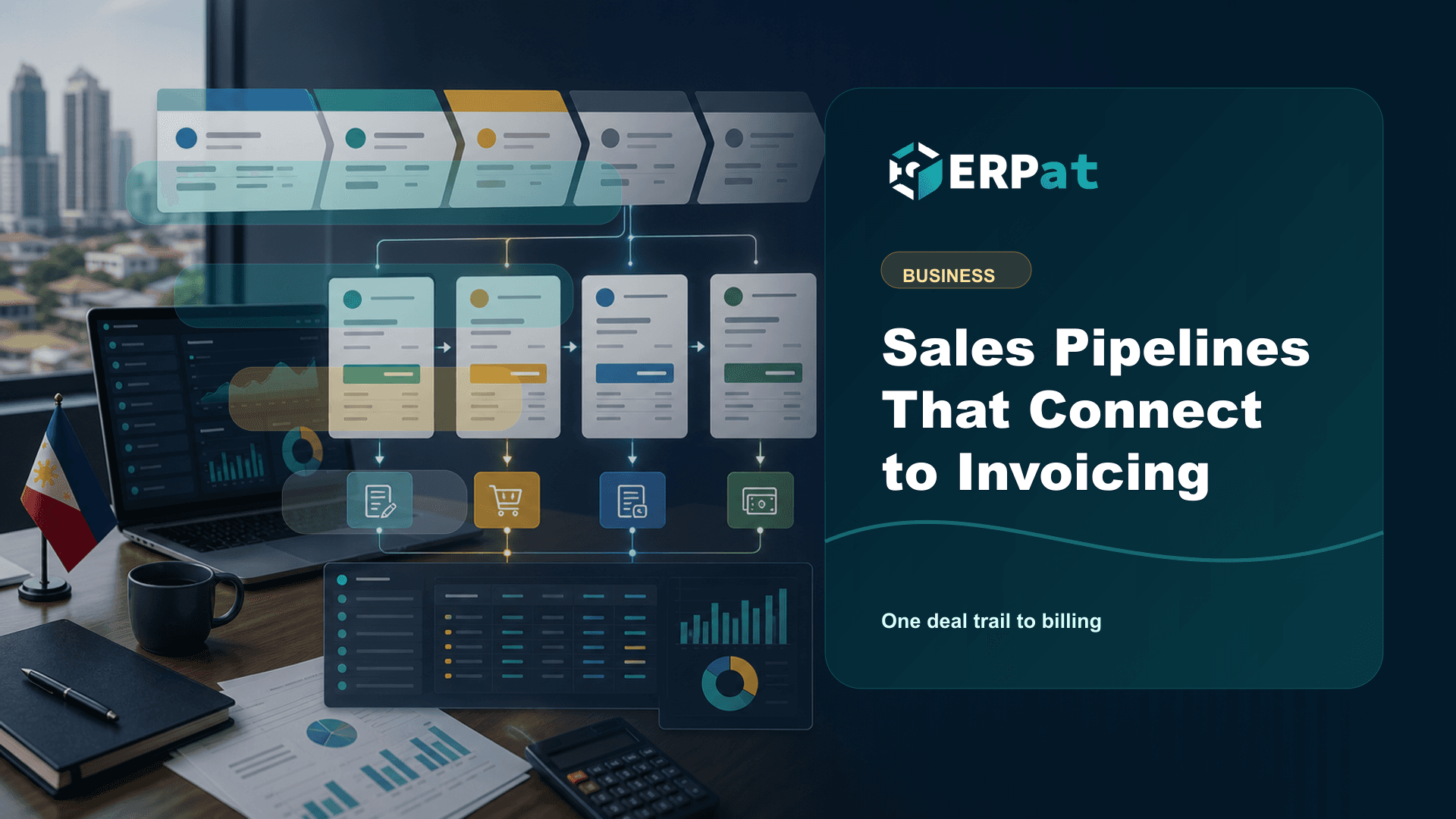
The alternative is to treat a deal as a single record that moves through stages rather than as a chain of separate documents that resemble each other. This is what the Sales module in ERPat is built around: leads, quotations, orders and conversions are tracked on the same thread, from first contact through to invoicing.
Practically, that means the line items entered once on the quotation are the same line items on the order, and the same line items on the invoice. What advances is the record's stage and the person responsible for it. When a client negotiates a change, the change is made on the record, and there is no ambiguity about which version is current — there is only one version, with a history behind it.
This also fixes the quieter problem of the missing paper trail. When quotations live in individual inboxes, a salesperson leaving the company takes half the context with them. When the pipeline holds them, the next person picks up an open deal and can see what was offered, when, and at what price.
What the pipeline tells you that a spreadsheet will not
Once stages are recorded rather than remembered, ordinary management questions become answerable. How many quotations are still open. Which ones have gone quiet. How many leads reached the quotation stage at all, and how many of those converted. A spreadsheet of closed sales tells you what happened; a pipeline tells you what is happening.
That visibility has a direct effect on cash. If you can see the value sitting at the order stage — agreed but not yet invoiced — you know what is due to become collectible, and roughly when. Most small and mid-sized companies in the Philippines run their cash planning on the invoices already issued, which means they are planning with the oldest information they have. The order stage is a better forecast because it is closer to the decision the client already made.
It also makes follow-up a routine instead of a reminder someone sets for themselves. A quotation that has sat unanswered is visible to everyone rather than only to the person who sent it.
Where finance picks it up
The handoff is the point of the whole exercise, so it deserves to be boring. When an order converts, the invoice is generated from the record rather than assembled from an email. The Finance module carries it from there, covering accounts, expenses, payments and reconciliation, with tax calculated automatically rather than worked out by hand on each document.
Automatic tax calculation matters more than it sounds. Manual computation on individual invoices is one of the most common sources of small, repeated errors — the kind that survive months of reviews because each one is too minor to notice and only surface when the books are reconciled or when BIR documentation is being prepared. Computing it from the line items, consistently, removes an entire category of correction work.
Payments then post against the invoice they belong to, so reconciliation becomes matching rather than investigating. And because the reports are drawn from the same records, the revenue figure finance reports and the figure sales celebrates are the same number, not two estimates that need reconciling in a meeting.
A joined-up pipeline removes retyping, not judgement — someone still has to approve pricing before a quotation goes out. If your team can issue a quote at any discount they like, connecting it to invoicing will simply deliver that discount to the ledger faster.
Making the switch without stalling the team
The work that actually determines whether this succeeds happens before anyone touches the software. You need one agreed list of products or services with current prices, because a shared pipeline exposes every version of the price list your team has been quietly maintaining. Reconciling those lists is usually a week of uncomfortable but valuable conversations.
Then define the stages in the words your business already uses. If your team says "for approval" and "awaiting PO", use those. Stages copied from a textbook get ignored, and a pipeline that people route around is worse than a spreadsheet, because it looks authoritative while being incomplete.
Start with new deals only. Migrating a year of closed sales is a large effort with a small payoff; the value is in what happens next. Let the historical records stay where they are, and give the team a clear date after which every new quotation is created in one place.
What actually changes week to week
The change shows up in the small things. Invoicing stops being a scheduled ordeal and becomes a review of records that already exist. Disputes get shorter, because the quotation, the order and the invoice are visibly the same document at different stages. And the weekly sales meeting stops opening with fifteen minutes of establishing whose numbers are correct. None of that is dramatic on any single day, which is precisely why it compounds.
Finance operations context
Use "Sales Pipelines That Connect to Invoicing" to tighten finance review
Accounting articles should help the team reduce reconciliation work and make records easier to explain. Read the guidance against how source transactions become reports, approvals and decisions.
Part 1Records that should connect
Finance teams lose time when sales, expenses, payments and approvals sit in separate places.
- Invoices, official receipts, payment status and customer balances
- Expense requests, approvals, supporting documents and account codes
- Payroll costs, government remittances and month-end summaries
Part 2Review controls to strengthen
A reliable finance workflow lets reviewers trace numbers back to source records without asking another team to resend proof.
- Keep approval status visible before reports are finalized
- Separate draft, reviewed and approved financial records
- Document adjustments with reasons and reviewer names
Part 3What better visibility should produce
The strongest sign of improvement is less time spent reconstructing what happened.
- Faster month-end close and fewer unexplained balances
- Cleaner audit trail for adjusted or corrected transactions
- Reports that operations and finance teams can both trust
Chelsea Cuevas
Content & Marketing Associate
Covers business growth, HR best practices, and the technology behind modern operations.