
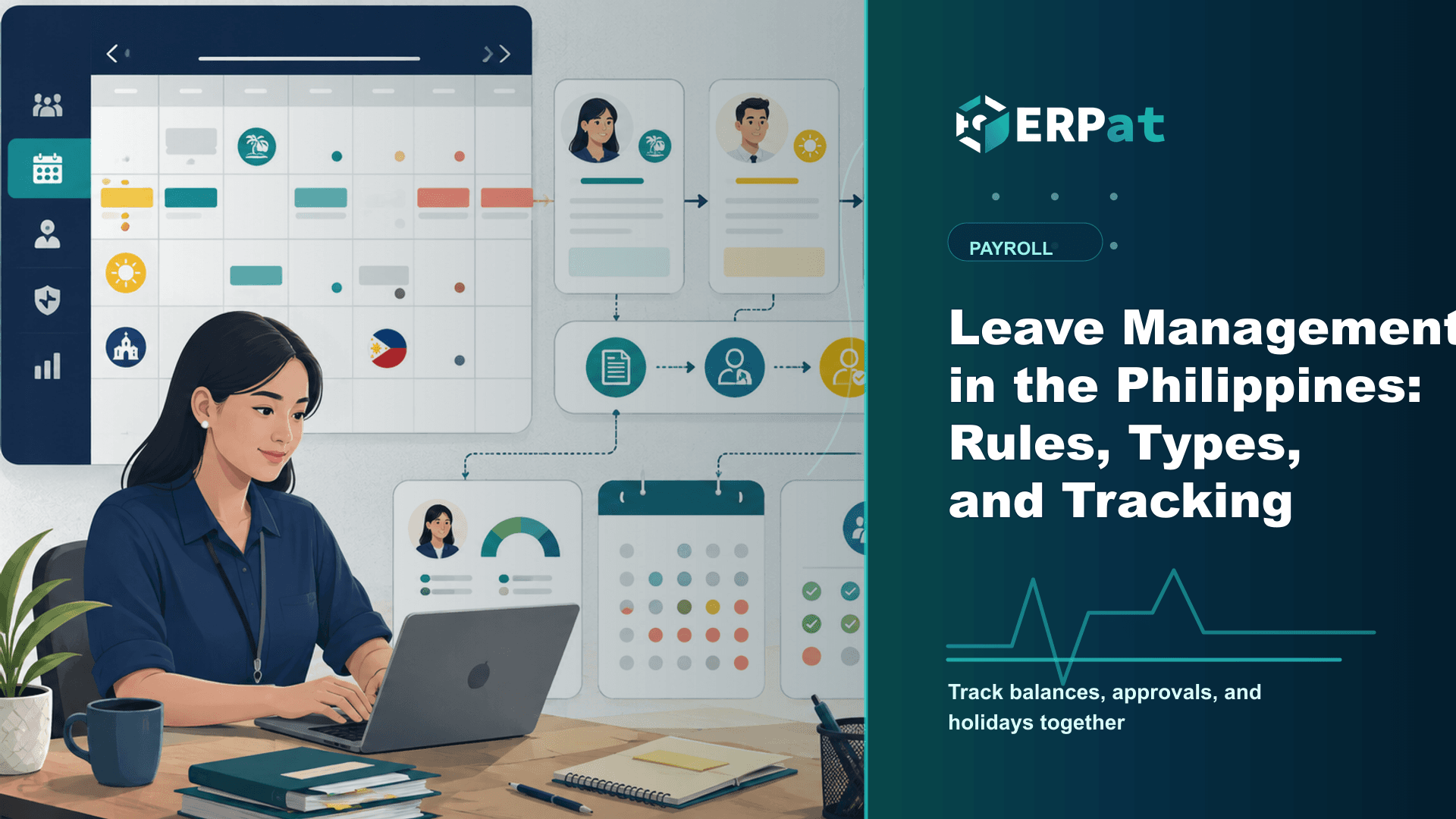
Leave Management in the Philippines: Rules, Types, and Tracking
Leave looks simple until someone asks for a balance. This guide covers service incentive leave, company leave types, how accruals actually work, and why a spreadsheet stops being trustworthy by mid-year.
In this guide
What to watch for
Use the article to spot where payroll checks can be clearer, faster and easier to audit.
In this article
Leave looks simple until somebody asks for a balance. An employee wants to know how many days are left before Holy Week, HR opens a spreadsheet that was last reconciled sometime in January, and payroll is working from a different number entirely. Philippine leave rules are not complicated, but they are specific, and they only stay correct if someone keeps count all year long.
The five days the law actually requires
Article 95 of the Labor Code entitles every employee who has rendered at least one year of service to a yearly service incentive leave of five days with pay. That is the statutory floor for paid leave in the private sector, and it is narrower than most people assume. The same article excludes employees who are already enjoying the benefit, those who are given vacation leave with pay of at least five days, and workers in establishments regularly employing fewer than ten employees.
Those exclusions cut both ways for a small business. A company that already grants ten days of paid vacation leave is not required to stack five more on top, because the plan it runs already satisfies the requirement. A company that stays below ten regular employees sits outside the coverage entirely, until it hires past that line and the obligation quietly begins to apply.
There is also a payroll consequence that is easy to miss. Under Rule V, Section 5 of Book III of the Omnibus Rules Implementing the Labor Code, service incentive leave is commutable to its money equivalent if it is not used or exhausted at the end of the year. Unused days are not simply forfeited. They become something the company owes.
Company leave types sit on top of that floor
Most Philippine employers do not stop at five days. Vacation leave, sick leave, emergency leave and bereavement leave are all common, and none are defined by the Labor Code; they come from company policy or a collective bargaining agreement, which means the employer writes the rules and is then held to them. The single most important line in that policy is whether the statutory five days are included in the company grant or added to it — settle that in writing once and it stops being an argument every December.
Leaves created by special laws are a different category and should never be drawn from the general leave bank. RA 11210, the 105-Day Expanded Maternity Leave Law, grants 105 days of maternity leave with full pay for live childbirth, 60 days with full pay for miscarriage or emergency termination of pregnancy, and an additional 15 days with full pay for a qualified solo parent, with an option to extend 30 days without pay and to allocate up to seven days to the child's father or an alternate caregiver. In January 2022, DOLE Labor Advisory No. 01, series of 2022, urged private-sector employers to adopt a paid isolation and quarantine leave program on top of existing benefits, without requiring one — exactly the sort of category a company adopts mid-year and then has nowhere to record.
Accruals are where the policy gets specific
Two companies can grant the same fifteen days and administer them in completely different ways. One credits the full balance every January and lets employees draw against it. Another credits a twelfth of the annual grant each month, so the balance builds through the year and someone who resigns in March has very little left to convert. Neither is wrong, but they produce different final-pay computations, so the choice has to be written down before anyone resigns.
The details that need an explicit rule are always the same handful: how a mid-year hire is pro-rated, whether probationary employees accrue at all, what happens to an unused balance at year-end, whether carryover is capped, and how a half-day is recorded. Remember too that Article 95 attaches only after one year of service, so anything a first-year employee receives is company generosity governed by policy, not a statutory entitlement.
Whatever mechanism you choose, two constraints hold for covered employees. The paid leave available in a year cannot fall below the five days Article 95 requires, and any unused service incentive leave is commutable to its cash equivalent at the end of the year. Everything above that floor is yours to design, provided the design is applied the same way to everyone.
Why manual tracking fails
The usual setup is a spreadsheet of balances plus approvals scattered across email and chat. It holds together in the first quarter and degrades from there, for reasons that have little to do with carelessness: the file is only as current as the last person who remembered to update it, and that person is usually the one processing payroll during the busiest week of the month.
The deeper problem is that approvals and balances live in different places. An approved leave sits in an inbox, the deduction sits in a workbook, and the actual absence sits in the timekeeping record. Nothing forces those three to agree, so a leave that was approved but never deducted looks identical to one that was never filed at all. Multiply that by a second branch keeping its own copy and the balances stop being defensible.
The errors then surface at the worst possible moments: the year-end conversion of unused leave, a final pay computation for a resigning employee, or an inspection where the company's own records are the evidence. Reconstructing a year of leave from an inbox is far harder than recording it once, as it happens.
Keeping leave, attendance and holidays in one record
A leave day is never just a leave day. It is an absence timekeeping has to explain, a balance HR has to defend and a pay line payroll has to compute, all sitting against a holiday calendar with rules of its own. Article 94 of the Labor Code entitles every worker to his regular daily wage during regular holidays, so whether a date is an ordinary workday, a regular holiday or a filed leave changes the payroll result. Those questions get answered by one record, or they get answered inconsistently.
ERPat's Human Resource module is built around exactly this grouping — profiles, schedules, attendance, leaves and holidays as a single employee system of record, instead of four files that somebody has to reconcile by hand.
Where to start
A system will only track the policy you give it, so write the policy first. Decide whether the statutory five days are included or added, how the balance accrues, what carries over, and what converts to cash at year-end. Then reconcile every balance once, as of a date everyone accepts, and treat that number as the opening position. From there, keeping leave current becomes a small daily habit instead of an annual reconstruction. The floor itself never moves — five days, after one year of service, commutable if unused — so the only real question is whether your records can show where each employee stands on any day of the year, including the day they resign.
Compliance context
Turn "Leave Management in the Philippines: Rules, Types, and Tracking" into a compliance checklist
Compliance-heavy articles are most useful when they become a repeatable review habit. Treat the guidance as a way to confirm evidence, ownership and timing before reports or payroll records are submitted.
Part 1Documents and records to prepare
Before the team reviews compliance requirements, make sure the supporting records are complete and traceable.
- Employee master records, pay history, schedules, leaves and attendance logs
- Contribution, tax, deduction and adjustment summaries
- Approval records, exception notes and revision history
Part 2Common gaps to prevent
Compliance gaps often come from missing evidence rather than missing intent. The system should make proof easy to find.
- Late updates to employee status, salary rates or tax/contribution details
- Manual corrections without a reason or reviewer attached
- Reports generated from data that does not match the approved payroll run
Part 3How to make review repeatable
Create a simple rhythm: prepare records, run checks, document exceptions, approve, then lock the final version.
- Use the same checklist every cutoff or reporting period
- Assign one owner for exceptions and one owner for final approval
- Keep final reports and supporting details together for later audit review
Jerome Evangelista
Content & Solutions Writer
Writes about payroll automation, HRIS, and how Philippine businesses run leaner with ERPat.