Overview #
The Transfer Module under Logistics is used to manage and track the movement of products or items between different locations such as warehouses, branches, or establishments. It ensures accurate documentation of stock transfers, including origin, destination, assigned personnel, and transport details. This module helps maintain inventory accuracy and supports efficient logistics operations.
Each transfer record contains essential transaction and movement details, ensuring consistency across logistics and inventory-related modules.
Key Features #
- Centralized management of transfer transactions
- Tracking of item movement between locations
- Assignment of dispatcher, driver, and vehicle
- Source and destination monitoring (From → To)
- Integration with Inventory and Logistics modules
- Export (Excel) functionality for reporting
- Secure role-based access
Accessing the Transfer Module #
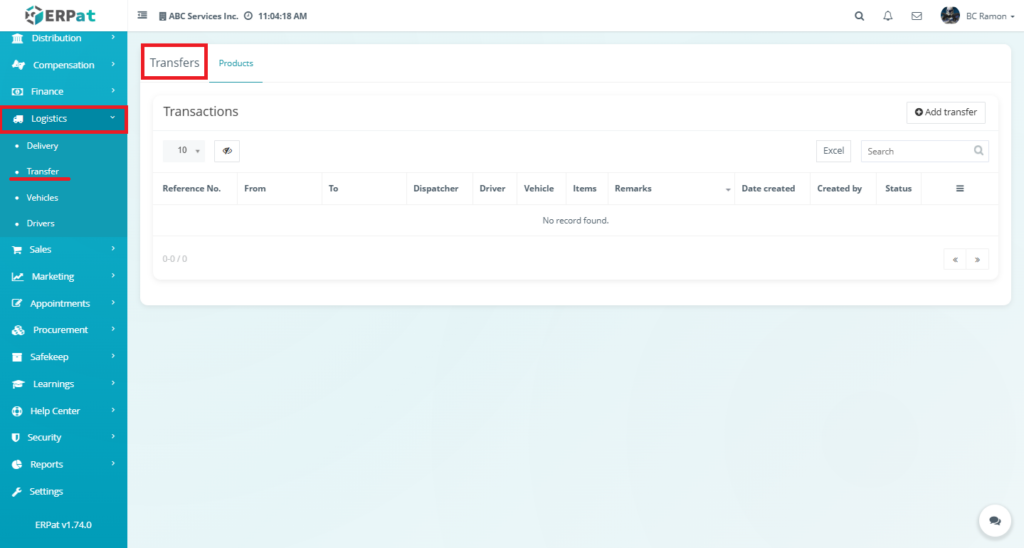
- Log in to the ERPat System.
- Navigate to Logistics from the main sidebar.
- Select Transfer.
You will be directed to the Transfer listing page displaying all existing records.
Transfer Listing Page #
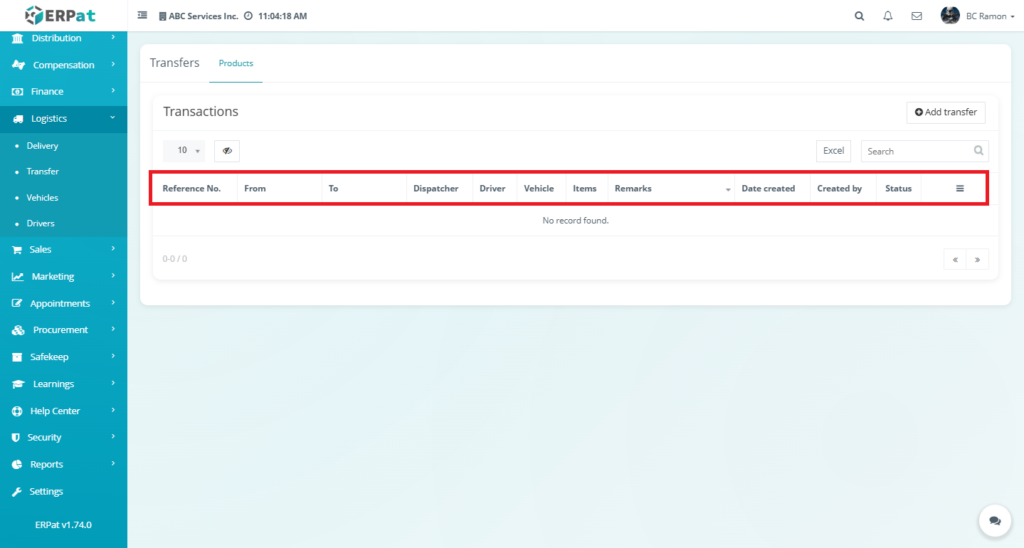
The listing page provides an overview of all transfer records with the following information:
- Reference No. – Unique identifier for the transfer
- From – Source location of items
- To – Destination location
- Dispatcher – Assigned personnel managing the transfer
- Driver – Assigned driver
- Vehicle – Assigned vehicle
- Items – List or quantity of transferred items
- Remarks – Additional notes or instructions
- Date Created – Record creation date
- Created By – User who created the record
- Status – Current transfer status (e.g., Pending, In Transit, Completed)
- (≡) Actions – Edit or Delete controls
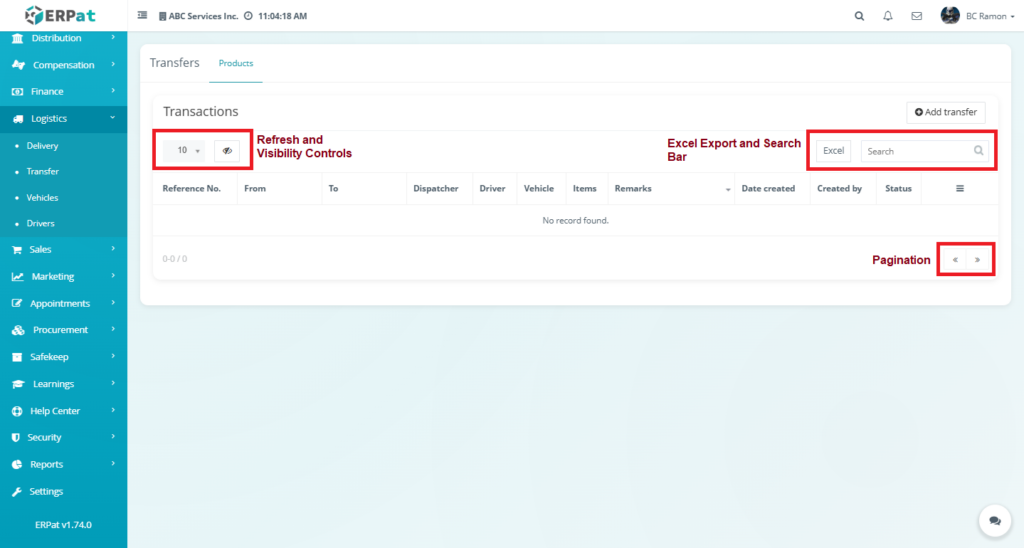
Additional controls:
- Refresh and visibility controls
- Excel export for reporting
- Search bar for quick lookup
- Pagination for large datasets
Steps for Adding a New Transfer #
STEPS #
- Click the Add Transfer button located at the top-right of the page.
2. Fill in the required fields:
- Reference No.
- From (source location)
- To (destination location)
- Dispatcher
- Driver
- Vehicle
- Items
- Remarks (optional)
3. Review the information for accuracy.
4. Click Save to create the transfer record.
Result #
The newly added transfer will appear in the listing and will be available for tracking and inventory updates.
Steps for Editing a Transfer #
STEPS #
- Locate the transfer from the listing.
- Click the Edit (✎) icon under the Actions column.
- Update the necessary fields.
- Click Save to apply changes.
Notes: #
- Changes will reflect across all linked logistics and inventory modules.
- Updating items or locations may affect stock records.
Steps to Delete a Transfer #
STEPS #
- Locate the transfer to be removed.
- Click the Delete (✖) icon under the Actions column.
- Confirm the deletion when prompted.
Transfer Status Indicator #
Displays the current state of the transfer process, such as:
- Pending
- Dispatched
- In Transit
- Completed
Used for monitoring item movement and logistics efficiency.
Search and Filtering #
- Use the Search field to find transfers by reference number, location, or driver.
- Pagination controls help navigate through multiple records efficiently.
Permissions and Access Control #
- Only authorized Logistics or Admin roles can add, edit, or delete transfer records.
- View-only access may be granted to supervisory or monitoring roles.
Best Practices #
- Ensure correct source and destination locations.
- Verify item quantities before confirming transfers.
- Assign appropriate drivers and vehicles for efficient delivery.
- Avoid deleting completed or inventory-linked transfers.
Audit & Logs #
All create, update, and delete actions for transfer records are logged for audit and compliance purposes within the ERPat System.
Last Updated: [March 18, 2026] Module Owner: Logistics IS – ERPat System


